


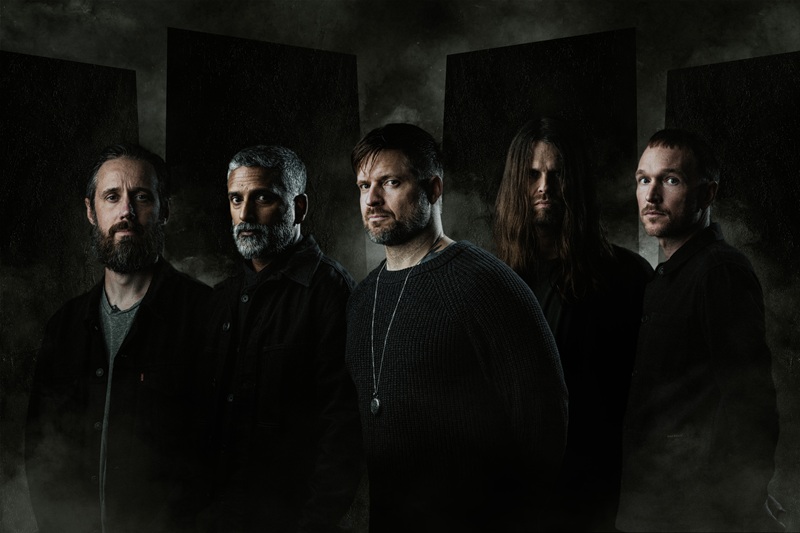
A new album created under circumstances that were the complete opposite of what the band had dreamed of. A musical family that has been together for thirty years. And the question of how to capture darkness, beauty and hope in a single composition. With In the Shadow of Your Shadow, Cult of Luna once again demonstrate that the Swedish post-metal band refuse to be constrained by musical expectations. Zware Metalen (Barry Hodiamont) spoke to drummer Thomas Hedlund about the difficult recording process, the special contributions of David Eugene Edwards and Joe Duplantier, musical freedom and the need to keep creating.
First of all, congratulations on the new album. I’ve spent quite a lot of time listening to it and I’m really impressed. Yet I understand that making this record wasn’t exactly easy. How do you look back on the recording process?
To be honest, it was a pretty exhausting and difficult process. Normally, making an album doesn’t feel like that for us at all. At some point, we mostly just wanted to finish it, so we could step away from it for a while and come back with fresh ears. We had hoped to repeat an experience we’d had with an earlier record, when we went to a remote studio on the Norwegian coast. That was truly magical. We could immerse ourselves completely in the music. We were working together almost day and night, experimenting, exchanging ideas and having the occasional beer in between. It was exactly how you imagine making an album should be.
This time, reality was completely different. Everyone had their own projects and commitments. I was going on tour with Yung Lean, for example, so I had to record all my drum parts before leaving. The other members had their own schedules too. Even the people living in the same city were hardly ever home at the same time. So we ended up working in a way where everyone recorded their contributions separately and we sent material back and forth. It was probably the least organic process we’ve ever experienced.
That’s surprising, because as a listener I find the album remarkably cohesive. Did those difficult circumstances affect the way you ultimately feel about the result?
That’s the interesting thing. The way we make an album doesn’t necessarily say anything about how somebody else experiences the music. It was our process, with our frustrations and difficulties. But that’s not the listener’s problem. When somebody puts on the record, they hear the music, not the circumstances in which we recorded it. The fact that we might have enjoyed making it less doesn’t mean somebody else will be any less moved by it.
I’m happy with the result now. We’ve started preparing for shows and tours, which means I’m working with the songs again. That also helps me look at them with a little more distance. In the end, the important thing is that we’ve made music we can stand behind.
One thing that strikes me about In the Shadow of Your Shadow is that it unmistakably sounds like Cult of Luna, yet it also contains quite a few new elements. How does that development happen within the band?
An important part of it is that we all have very different musical backgrounds and tastes. That’s really always been the case. For example, I hardly listen to metal myself. Not because I don’t appreciate it, but when I put on music at home, I usually choose something completely different. The same goes for the other members. We each have our own musical world. The funny thing is that Johannes sometimes doesn’t understand at all why I think certain music is amazing. I can be incredibly enthusiastic about something and he’s probably thinking: what on earth is this terrible music? But it works exactly the same the other way around.
That’s precisely what makes it interesting. When you make music together, you have to find something that connects you. You try to understand why someone else loves something, even when you don’t immediately hear it yourself. That can spark something in you. I find that an inspiring process. If everyone in a band listened to exactly the same records, wore the same clothes and had precisely the same musical ideas, I think that would be pretty boring, to be honest. Our differences mean we keep challenging one another. Eventually, we always find some common ground.
Does that also influence the way you write songs? There are moments when the music moves quite far away from what people might consider the typical Cult of Luna sound.
Absolutely. We’re trying to spend less and less time worrying about whether something sounds like Cult of Luna. Because what does that actually mean? What even is a typical Cult of Luna song these days? We’ve done so many different things by now that answering that question is becoming increasingly difficult. When somebody brings in an idea, we mainly want to discover what that idea needs. We don’t immediately try to decide whether it fits a particular style.
First and foremost, it has to be music that we like ourselves. I hope that, as the years go by, we give ourselves more and more freedom. That we think less about the image people have of the band and trust our own musical intuition more.
Your compositions are often incredibly layered. When do you actually know a song is finished? Is there a point when everyone is satisfied, or could you keep working on it forever?
That’s perhaps both the beautiful thing and the fundamental problem with art: it’s never really finished. You can always change something. Add another layer, try a different melody or approach an existing passage in a new way. And when you change something, new possibilities often appear. The longer you work on a composition, the more doors open. That can be incredibly inspiring, but it also means you have to draw a line somewhere. Sometimes practical circumstances decide that for you. A deadline is approaching, you have to go on tour or there are other commitments. Eventually, you have to decide the song is done.
But there’s something else, too. While writing, you sometimes hope for that unexpected moment when somebody comes up with an idea that makes everything fall into place. Something nobody could have planned in advance. Those are beautiful moments. You can’t plan them. You can only keep searching and hope they happen.
One of the things that makes Cult of Luna so special to me is the way you combine darkness and beauty. Sometimes I even hear a sense of hope or comfort in the music. Is that a contrast you consciously look for?
It actually happens quite naturally. Over the years, we’ve gained more and more ways of expressing different emotions in our music. Fredrik’s melodic vocals, for instance, have played an important role in that. They’ve opened up new possibilities for bringing different atmospheres and feelings into the compositions. But I don’t think we consciously decide that a song has to be dark and then needs a beautiful or hopeful section somewhere. That’s not how the creative process works.
What’s interesting about music is that you can access all kinds of emotions, regardless of how you happen to feel at the time. You can play an incredibly dark song while being perfectly happy yourself. There’s no contradiction in that. We carry all kinds of feelings with us all the time. Even on the happiest day of your life, there are things you can feel sad about. And when you’re going through a difficult period, there are still things that can bring you joy. Art allows you to connect with all those different feelings. To me, that’s one of the most beautiful aspects of making music.
How do you translate those emotions into your drumming? Do you have complete freedom, or are the other members closely involved in what you play?
I’m lucky that the others trust my musicianship. They give me room to develop my own ideas and make my own contribution to a composition.But at the same time, they listen very carefully to what I do. They’re interested in my parts and they give feedback. For me, that’s really the perfect combination. If you’re given complete freedom but nobody actually pays attention to what you’re playing, that can be lonely too. Eventually, you don’t know whether an idea is really any good.
I think it’s important that the others are involved. That somebody says when something works, but also when it might work better another way. We’ve been making music together for so long that we have a great deal of confidence in one another’s judgment. If, after all these years, we all agree something is good, at least we feel we’ve reached a certain standard. Of course, that doesn’t mean everyone outside the band will like it too, but that shared conviction matters to us.
Cult of Luna‘s music often conjures up very specific images and emotions. How much of a role do Johannes’s lyrics play in writing the compositions? Do the music and lyrics develop at the same time?
Not necessarily. Johannes writes most of the lyrics, and we usually don’t see them until quite late in the process. Of course, he’s been working on them for much longer himself, but by the time the lyrics reach the rest of the band, the songs are often already largely finished musically. So the lyrics don’t directly determine the musical direction of the compositions. Naturally, it may be different with songs Johannes writes himself. I can imagine the music and lyrics influencing one another during his own creative process. But for me as a drummer, I’m usually working with the music first. I try to understand the atmosphere and emotion a composition evokes and make my own musical contribution to that.
One of the tracks that really stands out to me is A Way Back. It’s a relatively restrained composition, with an almost comforting atmosphere. At the same time, there’s something unsettling beneath the surface. How did that song come about?
That song came from Fredrik. He had a musical idea that we then started working on together. We all love artists like Tom Waits. He’s somebody who has created a musical world entirely his own. We wanted to venture a little into that world, although somebody like Tom Waits is obviously miles above us.
What’s interesting is that we don’t immediately judge an idea like that by asking whether it fits Cult of Luna. When Fredrik brings in a song he likes, we try to discover what it needs. We don’t have to stay within the boundaries of what people expect from us all the time. I can imagine A Way Back being one of those songs that some Cult of Luna listeners fall completely in love with, while others might not connect with it at all. But that’s fine. The important thing is that we have the freedom to make songs like that.
I actually hope you’ll play A Way Back live as well. I’d love to hear how a song like that works within the intensity of a Cult of Luna concert.
I’d certainly love to play it!
The album features two remarkable guest vocalists: David Eugene Edwards on One More Day and Joe Duplantier on Sadness Will Reign. Let’s start with David Eugene Edwards. How did that collaboration come about?
David has been one of Johannes’s heroes for an incredibly long time. He’s somebody whose music Johannes has admired for years. When you’re young and just starting to make music, some artists seem almost unreachable. You can hardly imagine ever working with them. But at some point you realise you can simply ask. The worst somebody can say is no. We’ve also worked with Mark Lanegan in the past, for example. That would have been unimaginable to us as young musicians.
With David, it was naturally very personal for Johannes. I think he was pretty nervous when he finally wrote that email. Luckily, David responded very kindly and enthusiastically. He was open to collaborating and turned out to be willing to put a lot of time and energy into it.
What strikes me most about One More Day is that his contribution goes much further than just adding a recognisable guest voice. He really seems to become part of the composition.
That’s exactly what we’re trying to achieve. Johannes had given David the freedom to contribute lyrically as well. And then he came back with an enormous amount of material of his own. Johannes could hardly believe how much time and energy David had put into it. That was really special. When you invite somebody to contribute to your music, you naturally hope they’ll bring something of themselves. And with somebody like David, that almost goes without saying, because he has such a distinctive voice and musical identity. His contribution gives the song something we could never have achieved in exactly the same way ourselves.
And how did things work out with Joe Duplantier? Johannes and Joe both have incredibly powerful voices, but each has a very distinct range and character. That’s exactly what makes their combination on Sadness Will Reign so impressive. Was approaching Joe just as nerve-racking?
I think that was a little easier. Our manager Alexis is French and knew people around Gojira. And of course, we already knew their music and they knew ours. So asking whether Joe might be interested in contributing was a fairly natural step. It wasn’t one of those situations where somebody spends fifteen years being nervous before finally daring to send an email, haha. But the result is really beautiful. As you say, Johannes and Joe both have powerful voices, but with very different characters. That’s precisely why they complement each other.
What makes a collaboration with a guest musician truly successful for you?
The most important thing is that somebody adds something we can’t do ourselves. When you invite a guest musician, you want them to bring their own talent, creativity and musical world. With a vocalist, that’s fairly obvious because every singer has their own voice. But it’s just as true for instrumentalists. Take Colin Stetson, for example, who played on our previous album. He did things we wouldn’t even have thought of ourselves. We couldn’t have imagined certain ideas, let alone performed them. And that’s exactly what you want.
When you ask somebody to bring their creativity to your music, you also have to give them space. You have to be able to say: do your own thing. Because if we were going to tell somebody exactly what to play or sing, we might as well do it ourselves. The interesting things happen when somebody adds something beyond our own musical abilities or imagination.
Looking back a little further at Cult of Luna‘s development: A Dawn to Fear was my favourite album of yours for years, but I’m finding that the new record is seriously challenging that position. How do you look at the band’s development, both musically and personally?
Oh, cool! What’s so special to me is that we’ve been making music together for an incredibly long time. Johannes and I have played together since we were sixteen. That’s about thirty years now. Of course, I haven’t been part of Cult of Luna for all that time, but we’ve been making music together for almost our entire adult lives.
Life consists of all kinds of paths running alongside one another. Some paths keep changing, others disappear or new ones emerge. But this musical path has been a constant for almost my whole life. We’ve been through an incredible amount together. Beautiful moments, difficult periods and everything in between. We’ve shared a huge part of our lives. And the funny thing is that we still feel as though we’ve only just started.
When we get together, we usually have a fantastic time. We genuinely enjoy each other’s company. Of course, making this album wasn’t exactly the most enjoyable period, but generally it’s still wonderful to make music together. We’ve basically grown older together. And I’m sure we’ll keep doing that.
Can you hear that shared history when you listen back to the older albums?
Absolutely. Every album captures who we were at that particular moment. I sometimes compare our discography to a photo album. When you look at old photographs, you don’t just remember what’s in the picture; you remember all kinds of things that were happening in your life at the time.Music works in exactly the same way.
I should add that I don’t listen to our own albums very often, haha. But if I did, I’m sure all kinds of memories would come flooding back. Every record represents a particular period in our lives. Not just musically, but personally as well. That’s why I find it difficult to judge our development purely in terms of better or worse. Of course we change as musicians and as people, but every album has its own significance. It’s a kind of imprint of that particular moment.
Does getting older and gaining more experience also mean you become freer in your musical choices?
I hope so. I think you have to dare to give yourself more and more freedom. To worry less about who exactly you are as a band and how you’re supposed to maintain that image. When you’ve been around for so long, a certain identity naturally develops. People have expectations and recognise certain elements in your music. But if you’re constantly trying to live up to those expectations, you limit yourself. I hope we think less and less about how we’re supposed to sound as Cult of Luna, and make more and more music that we genuinely like ourselves. Ultimately, creating something together has to remain fun and inspiring.
I’ve seen you live about ten or eleven times over the past few years. One thing I’ve noticed is that the stage presentation remains fairly recognisable. Can we expect a different atmosphere or perhaps even a different approach with the new songs? Without giving too much away, of course.
I’m not sure how much I can say about that. More than anything, I hope the new songs themselves add something different to the atmosphere. That the music opens up new possibilities and brings something new to the live experience. What I find interesting is that making an album and performing that same music live are really two very different processes. When you’re working in the studio, you can use every resource available to you.
If a song needs four different drum kits, each with its own sound, you can simply do that. It doesn’t really matter how many layers you add, as long as they serve the composition. You try to develop the song as far as possible and explore every possibility. But when you then perform that same composition live, you have to rediscover which elements are most important. You look for the core of the song. Which elements are essential? What absolutely needs to remain in place to preserve the same atmosphere and intensity? I find that an incredibly interesting process and I’m looking forward to getting to work on it.
Of course, you also have the advantage of having two drummers on stage.
Exactly. I’m lucky to have Kristian playing alongside me. He’s a fantastic musician and can play pretty much anything. That gives us an enormous number of possibilities. We can divide parts between us and combine different rhythmic layers. That gives us a great deal of freedom when translating the studio versions to the stage. And it’s also just incredibly fun to do.
One song that immediately caught my attention is The Rift. It has an almost hardcore-like energy. Normally, your drumming is often very considered and layered, but here it sounds as though you can simply let loose. What’s that like?
I definitely love that! But it’s also going to be a difficult one to play live. Playing fast isn’t exactly my greatest strength. The funny thing is that I’m now in a punk band with Dennis from Refused. It’s pretty comical to start a fast punk band when you’re in your forties. It has made me practise playing fast a bit more, but it’s still not my strongest point. With this song, it’s mainly about energy. As you say, it has that hardcore feel. It just feels fantastic to let that energy out.
You’ve been making music together for around thirty years now. What still makes it exciting, after all this time, to create new music and explore new musical directions?
I think that over the years it actually becomes a need. Music is an emotional place you can’t find anywhere else. And that’s why you keep coming back to it. When you’re a musician, that never really stops. You don’t stop being a musician when you’re not on stage or rehearsing. It’s always part of who you are.
What you use when you make music is ultimately yourself. You use your own emotions and try to express them in a way that matches what you’re feeling. That’s incredibly special. I think we’ll always keep returning to that place because it’s something you can’t find anywhere else. It’s a beautiful space in which to express yourself and connect with your own feelings.
We’re also incredibly lucky that, after all these years, we still love each other and enjoy being together. There are plenty of bands that have been around as long as we have, but whose members can’t actually stand one another anymore. Yet they carry on because there’s enough money involved to make stopping difficult.But we never started a band because we wanted to make money. It comes from somewhere else. Making music is ultimately a very vulnerable thing to do as well. That’s why there has to be a genuine need to do it.
Cult of Luna’s new album was released on 6 November. The band will perform in the Netherlands and Belgium on 4 March 2027 at Muziekgieterij in Maastricht and on 7 March 2027 at Ancienne Belgique in Brussels.
Links: