




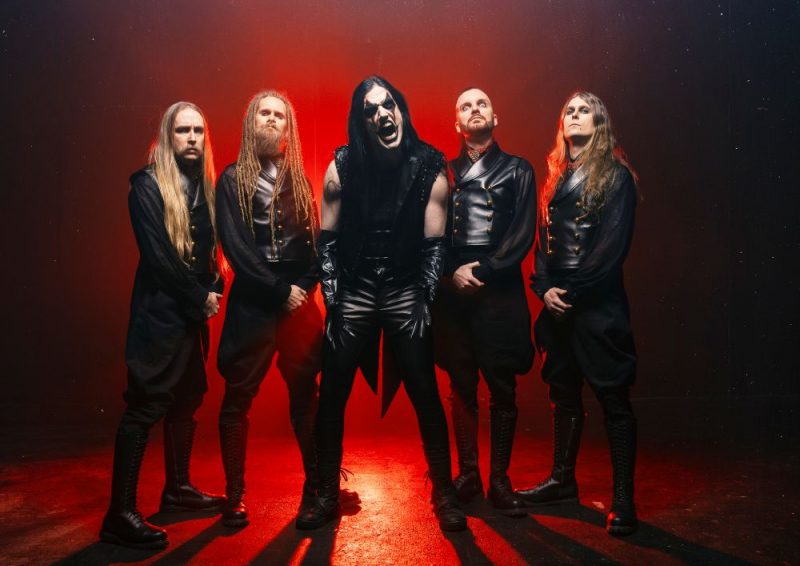
Note to self: if you’re going to interview Johannes Eckerström from Avatar, do not prepare too many questions. Of course, I had done just that before traveling to meet him in Amsterdam, but Johannes turns out to be a charming chatterbox who tells his stories almost in a stream-of-consciousness style. The result is a kind of rollercoaster experience which seemingly shoots off in all directions, yet somehow always ends up exactly where we need to be. Because when transcribed the recordings, it turned out Johannes actually had revealed quite a lot of interesting information about his band’s new album. Oh, and about touring with Iron Maiden, about headlining the Alcatraz Festival, and on why darkness and light don’t truly contrast… Buckle up—here we go again!

Hi Johannes, just a month ago you were on stage headlining the Alcatraz Festival and now you suddenly find yourself at a table doing a round of press. That begs the question: how are you?
Good, thank you for asking! Especially now, because the thing is that we didn’t do this kind of press before for years. First because of the pandemic and then everyone got used to Zoom… So, that is what we did for the last album. Therefore it feels a bit special. And I am still enough of a kid in my head that I get smitten by the whole ‘jet set vibe’, that I can see the charm in flying between European metropolises to talk about myself (laughs). We’re not a top 40 pop band. So, I don’t need to spend three months doing this. It’s a week, so the novelty of it is very nice, thank you very much.
And you’re still able to talk enthusiastically about the songs. After three months it probably would get a bit boring.
Exactly! And the top 40 acts get to do weirder things. Being on TV and being in a ball pit. We don’t get to do that.
You never know what the future holds! It’s been two and a half years since Dance Devil Dance was released. Since the release, you played a lot of shows. There were a lot of bigger shows: you headlined your own Great Metal Circus and supported Iron Maiden for instance. Have there been shows that really stood out for you in the last two years?
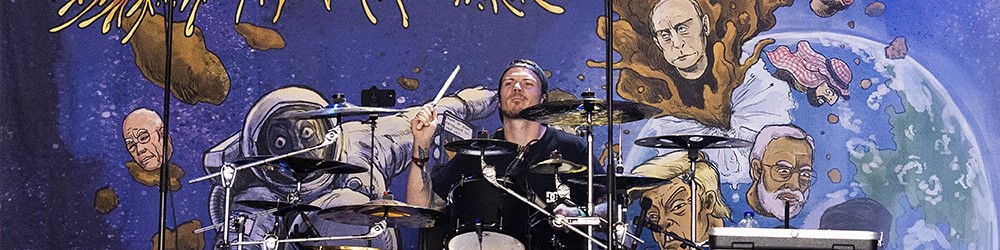
Probably, but I have to give it some thought. Because if I limit it to the past two years I have to try and remember where we even were in that period of time. I can actually… the Belgian show, the Alcatraz show, the last one we did, really stood out. Of course, we had a good time playing stadiums with Iron Maiden. But we had a good time while working really hard on introducing ourselves to a big new audience. This means that we really had to pay attention. I come up on stage, go out on my little gift box and look and listen: to understand where the audience is and therefore where do I want to bring them. We did well and that’s what we do. It was cool and a pretty nifty way to spend a summer… But it was work.
And after doing all that, we went to Alcatraz, where it was also a big-ass audience, but it was our people. They were in mosh pits and crowd surfing and they knew the lyrics already and all that. So I was listening: where are they? Where do I need to take them? And then I came up on stage and noticed: they’re already there! There’s always a give and take with the audience. But the fans started so giving. So after that month of proving yourself, you kind of get to feel on top of the world. Or more at home in a way. So that made that show, for instance, very special.
So that definitely works for you? Years ago – around 1996 maybe – I went to see Soundgarden in a club show. Before the band came on, the crowd was already roaring. When Chris Connell came on stage, it looked like the enthusiasm of the fans took away his energy: they’re already there!
That’s interesting… No for us it’s certainly that give and take thing. It’s a bit cliche of a singer to say that we’re half the show and the fans are the other half and that we do it together. But it’s so true for the best shows. In these shows you create a communal thing. And also, because even if the audience starts there, there is al long way to go, because our stage was for two hours with a plan. And the theatrical aspect of what we do means that we still need to take the people on a journey. With a longer set, especially, it’s still about putting in the work in terms of where you want to go with it and to maybe, in a way, taming and steering that energy, even if it starts on top, you know.
But also I can relate a bit to what you said. I think there are different types of joy. One is getting to put in the work and going on that journey and feeling that you nailed it. Then you get the reaction from what you did right at that moment. As opposed to that you’re being rewarded for what you have done for years leading up to that point. But, I mean, we’re not famous enough where I have gotten a chance to get too used to it. We are not on the level of Soundgarden in 1996. So, I mean, maybe I get bored with it, but not yet.
Did you take something from these experiences in the live shows to the new album?
Probably. Because that’s the process. In that each album becomes that snapshot of… Because we don’t work really with a formula where we rinse and repeat. So, therefore, whatever happens in life at some point triggers what comes next. Sometimes part of it is that, if we feel good about what we did – which so far we do every time –, that also means that we end up feeling done and bored with what we’ve done. Not so much on stage, it’s still fun. I’m not bored doing Dance Devil Dance live, but still I feel artistically kind of finished with whatever approach we had on that album. And therefore each album becomes a reaction to whatever happened before.
So, you start to come up with new rules for yourself, a new framework. Dance Devil Dance was very much intended to be more straightforward. In my mind, it’s a rock’n’roll album. You know, play the riff, then play the chorus, and boom, boom, go. A lot of the songs are like that. It has an overarching kind of vibe to it, in my mind. And for a new album, you let go of it. Then, instead, it’s taking more twists and turns and, you know, dead and gone and back again. And it suddenly goes into double speed and speed metal in the middle and stuff. That was kind of against the rules for Dance Devil Dance. For that album we did not want to do a slow song that then becomes fast. On that album each song is its own dance. And if you play a bossa nova, you don’t do a salsa piece in the middle. The next dance can be a salsa. So, you play a slow song, then you finish that, then you play another song and that can be fast. But this time: screw that! That gave a lot of freedom.
Freedom to follow the song to where it wants to go?
Exactly, yeah. We’ll go there and we’ll see what works. As a fan of music, I truly like a billion different approaches. I can appreciate Genesis as much as I can appreciate AC/DC, talking 70s stuff for instance. But clearly, they build completely different frameworks and ideologies. So, I don’t believe that there’s one truth to what makes the right way. But I do believe that you kind of need to commit to one line of thinking at the time. You cook pasta or rice, one at a time. I don’t say that rice is better than pasta, but it’s a one at a time kind of thing. You have to commit to a way of thinking to make the albums, especially because clearly we are fairly eclectic in what we put on an album. There still needs to be, at least to us, some overarching sense or view to it.
Over time you mean? Because it’s written and performed by us. When I say it like that, it sounds cynical, but it’s the truth. In the talk I had before, The Beatles came up. I am a big Beatles fan and look at what a wild journey they took in just… about eight years. But it always sounds like The Beatles. It’s not that Come Together sounds less like The Beatles than Please Please Me did. The thing is that were their own ideas with their sensibilities and their abilities, but also their limitations. Because they are who they are. They’re stuck with themselves and I think that’s the secret sauce.
Like, I try to learn new tricks as a singer and improve, but I’m still stuck with my own mouth. And that creates that I sound like me no matter what I try to do.
So, there’s never an idea or a song that gets scratched because it does not sound enough as Avatar?
No, because if all five of us find reasons to like it and wan to work with it, then it clearly is Avatar, because we are Avatar. I like to watch jazz musicians explain chords to me on YouTube and then try them on the piano. And then sometimes I like to dip my toe into a different genre and borrow a little piece, but Avatar would never make a jazz album.
It still is all about filtering into heavy metal. So, that’s maybe the only part that is a formula, the only part that sets the rules: Avatar is a metal band. A metal band that grew up listening to 70s and 80s stuff, while learning to play technical death metal and coming from Swedish West Coast. And all those things that shaped us while being very young became part of the DNA and of where the fingers go on the guitar neck.
And even when you say Avatar is a heavy metal band, there is a track like Howling At The Waves with a lot of keys and melancholy.
Sure, sure, but there’s always room, I mean… kind of like Black Sabbath did with Changes. We don’t need a ballad every time, but there’s room for something like that, if need be. On the last album, with train (although not a ballad) there was also room for that little thing. So we’re not that strict but, but at the same the song treats the piano part as kind of the main riff. Therefor the methof is still very similar to… I mean, if I say it out loud, it’s very obvious, but the whole idea if you’re a heavy metal band, is all about Black Sabbath in a way and it’s all about, therefore, coming up with a riff and then figure out what makes the most sense for the drums to do. And when you nail that, if it’s done right, it should trigger emotions beyond, oh, cool riff, cool beat. When that all blends together you see a city landscape, or you see war, or you see the forest or whatever it might be. It’s in that, between the groove and that main theme.
Howling At The Waves happened in the same way. I had those ideas on the piano and we’re working on it, but it wasn’t until – during a soundcheck – John (Alfredsson, drums) started to play along to me sitting by the piano, doodling, and found the right beat for it. We’re like: okay, now it’s a song. Yeah, and we’re at the beach. There’s that melancholic thing and I started just moving my head along to it. It reminded me of… Well in parts it’s taken from a dream I had, a bit similar to moments in the film Eternal Sunshine on the Spotless Mind. You know how, they’re on the beach there and how the world falls apart around them and they delete his memories? I had a dream that wasn’t far away from that, just trying to make it from these massive waves climbing up. You know, when you try to climb in a dream and it’s completely vertical. I was climbing vertical, being pulled down by the waves, and I’m trying to drag my at-the-time-soon-to-be wife with me, not giving up. That kind of struggle is the feeling I got from the music. Somehow, the drums with the chorus chords, just started to paint those pictures and then I knew: oh there it is. And that is exactly the way Hail The Apocalypse was made too, except that that was delivered to me as a lyricist, because Tim (Öhrström, guitar) already had the riff and the rhythm for it. So simply you hear that, and to me, that’s a man standing on the street, and he holds his sign: the end is near. It’s a doomsday prophet in the middle of a city. And he looks up, and the bombs are falling. The end he was praying for is coming. If the music itself triggers my imagination, then there’s a song. It’s not only for these two songs, it’s just a picture that comes up, almost a story and a feeling.
Some people in music have synaesthesia (the production of a sense impression by another sense, Devin Townsend says he sees music in colors, MH). I don’t have that, but I think my version of that is a bit more… oh, I don’t know, intellectual. Like I need to put some words on it and paint a picture. From a basic level a great ZZ Top riff makes you feel like you’re driving. You can sit by the dining table, but your foot goes down. And the weather is nice, you know. I think we all feel that to a different degree, and because I write songs, I practise on articulating that. There’s music that sounds more rainy than other things. I just discovered that when I was playing piano at home. My side project is basically doing melodies on the piano, just draw on the sand and remove. I don’t need to finish the songs, I just come up with things in the moment. I was doing that and I really liked where I was going. I was wondering why I liked it so much and I looked up and noticed: oh yeah, it’s raining! Some music sounds like rain, some music sounds like sunshine. When you really start feeling these things, you can get way more detailed and advanced. And that usually is also a way for me to measure the quality of an idea, be it my own or somebody else’s in the band. If it paints a picture, then that usually equals a hooky riff. But I don’t think in terms of a radio-friendly riff. It’s more like: oh, that’s a car.
So if music is inviting you in, it’s usually not because it brings you questions on how the notes go together from a more (music)theoretical perspective?
That’s part of the process of being into music and I’m also a bit of a music theory geek. And again, I like to learn. From time to time, I pick up an old jazz song, and look into what that chromatic thing is that they play that somehow makes sense. In theoretical terms: but you raise the fifth on the dominant, and that then gives you a leading two-note, so you can chromatically go down there. When you find out how they do it, then you start to try to learn it, and learning sometimes result in you using it. Sometimes consciously – I want to do something with this – but sometimes just because you have it in your fingers or in your head and it organically grows into something. Then you use 1% of that jazz concept to just move your finger a little bit different than you’ve done the last twenty years.
The press release states that the album is all songs and concepts you haven’t been close to touching until now.
Or at least in a way that it hasn’t been done yet by us.
It also says that the time wasn’t right for you to do these things before, but now the time is. It almost seems to imply that in the past you wouldn’t have dared to go there.
That’s probably true, in the sense that every time we make an album, we feel: finally some honesty! But we were just as genuine and authentic to ourselves back then. If you allow yourself to grow and mature and change your mind on things… A human is an onion and you can always peel away another layer of bullshit. And that shapes how things are being said. Maybe I’m slowly, slowly working my way towards where by the age of 70 I might be man enough to write the lyrics “Baby I love you”, for instance. I’m not there yet but there is Howling At The Waves and relationships certainly shaped a bunch of songs in the past as well. A Secret Door was kind of like that as well for instance and Paint Me Red is certainly like that. But I think it’s even more in Howling At The Waves. That kind of vulnerability for instance. But then there’s also Magic Lantern that just reflects on childhood in a way that I didn’t really find space for prior to this album.
And a lot of it is coming from dreams or a more intuitive place. That was a cool thing for me when it came to lyrics this time: I think for all of us – no matter if it’s about writing a song or remodelling the kitchen or thinking of what birthday present to give to someone, it starts with ideas, right? Not just artistic ideas but maybe even more so with artistic ideas, they start in a very abstract place, the first impulse is somewhere in your subconscious. In what you think about when you don’t think. If you imagine that you dive into that dark lake, swim to the bottom and find in the mud a little shiny thing, – a lot of times then when you wanna turn that idea to a song – you swim up and you look at it and start asking questions: what is this? What does this mean? What can I turn this into? You try to validate it by understanding it as fast as possible. Is the song about my wife or is it about Putin? Like it’s important to know that right now.
This time I’ve stayed in the water longer and kept writing. Trust the process seems to have become the next step: trust what’s beautiful. So trust that the subconscious is helping me piece it together, where I don’t need to get in the way of it immediately by looking for answers in it. So that made some songs come from a more abstract place but through my subconscious I know they have a connection to the meaning of a song. Take This Heart And Burn It is very much one of those songs for instance. And Captain Goat, that maybe is less surreal as an end product, but also started from a sound of singing. Like it really chanted the way up, closer and closer to the surface of that idea and it became very concrete: this semi-satanic anthem about this symbol of the goat and everything but it grew there organically.
It’s the same with the word ‘warrior’. My brother at some point made a metal playlist in which he only had songs with warriors. It’s great, but lyrically: yes and no. Warriors Of The World on the right night in the tour bus? Hell yeah! But there is also redistribution of wealth, the power of the many and solidarity. All these things. How do you do heavy metal with that? So there I had to work a bit more methodological. The idea, the impulse still from the lake but there maybe I swam a bit faster to the surface because I had a puzzle to solve a bit to figure out how to say these things that felt important and then therefore that the river runs red and the blood is red. So the colour red is there for those reasons. It’s explicitly WE that must be warriors and ‘must’ is a term of sacrifice, of doing what’s necessary and coming together. It’s also about that you are one of many, and I see what you’re going through. But there’s many of you and you have dreams and once we come together, we start to become a problem. And that’s a good thing that basically means: unionise!
Wow, I picked up on some of that when I listened to the song but not all of it…
So many times in the past, I wanted to do that kind of “here we go” take on lyrics, because if you don’t there’s a certain level of responsibility, when you start writing like that. I saw a documentary about Beethoven’s 9th and after his death he has had all these different ideologies, because of how his work has been used. They made Beethoven a nazi and a communist and he’s been the harbinger of the European Union. He’s been all these things. And because of the joy (in the symphony) that can be that we make America great again or we start a union. There sometimes is the temptation of just going for that “us against the world” language: “They’re not gonna stop those bastards”. But then it doesn’t say if those bastards are capitalists or people of a different race than I am or something. I need to take a couple more steps with it to make somewhat clear what it’s about, so then I leave those clues there in to who needs to be a warrior and what it means to be a warrior as opposed to a soldier for instance.
Did the red in the black album cover come from the same place?
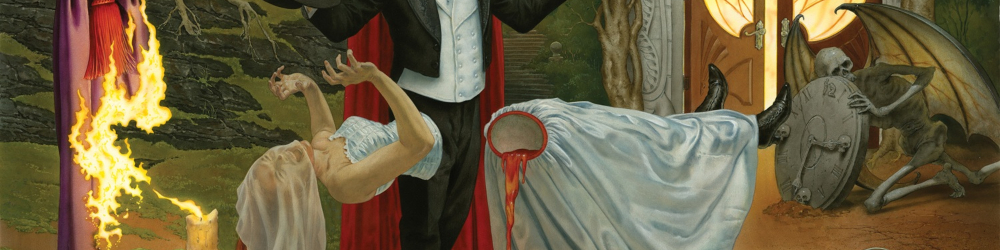
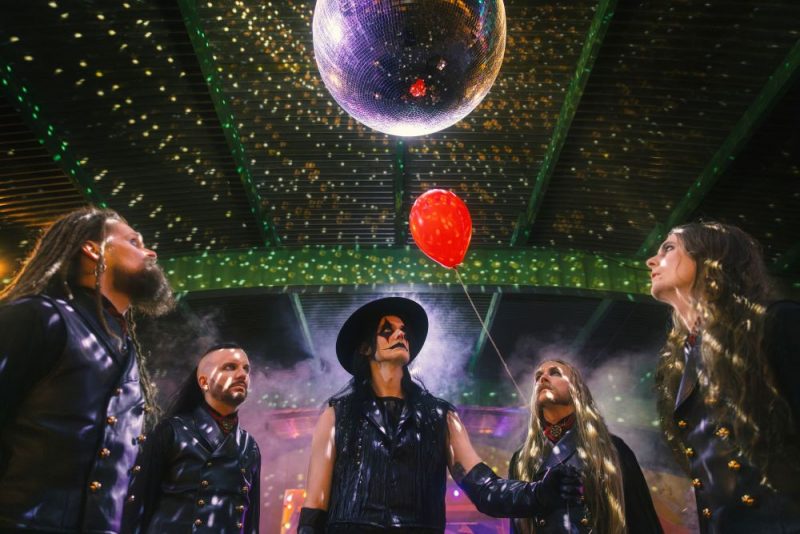
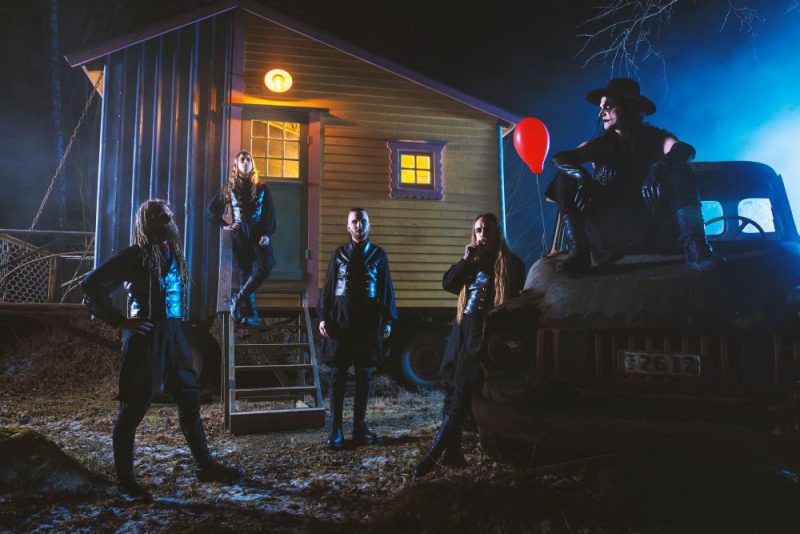
No, that just looks cool! It’s a cool contrast. The album cover needs to be about all the different things on the album. The social democrat Manowar song is one thing, then there is the song to my wife and weird dream visions. The surrealness is one thing, but then there is the heavy metal good time vibes. Don’t Go in the Forest as a title is about dwelling into the darkness and because we say “don’t do it”, hopefully it means that you totally want to do it: breaking the taboos and things, that aspect of especially heavy metal and what we do. The balancing act that all heavy metal bands work on/with. Because heavy metal is a really good time and it’s excitement and it’s songs you can party to, or get you stopped by the police because you drove too fast, or you can hear in the gym or in the mosh pit. Soundtracks to all these things. But then thematically – and what we use it for psychologically – it’s a damn dark place and somehow we need to do those things. Like you go to Metallica and cheer and drink beers to a song about a man without arms and legs who really, really wants to die. And we don’t stand there being bummed out with that. That’s balancing on that edge. And especially Avatar with the visual side, the theatrical side of it, how over the top we bring those things. You need to bring all these things along somehow.
You sometimes seem to push these two sides of metal a bit further apart than other bands do. Take This Heart And Burn It for instance is musically very upbeat and almost festive while the lyrics are about…
Losing your fucking mind! Part of the reason might be that it doesn’t feel like a huge contrast to me. There’s the exciting kind of melody and the beat that goes with it, how it kind of drills into your skull. And the common denominator between that and the lyrics is the madness. That is the bridge between the two. It’s the pounding fever dream feel of it. It’s probably also the most surreal song lyrically. It’s another song for which I used a dream. I was in a very vivid, specific place of – like a lagoon or a Caribbean or tropical place. It’s a dream so I was able to fly (of course) and I see these drowned pilots under the water trying to make it to the island. It’s this dangerous place and and amidst all these naked people that have been there forever there is a naked girl with tanning lines so I think: oh you’re new here, and then more weird stuff happens about being new to this strange place. It was extremely vivid and of course somewhat senseless. One of the worst, boring conversations you can have sometimes is about dreams. My dad told me: I hate it when someone tells me about their dreams, because it’s about something that did not happen. And then he would always tell us about a dream he had (laughs).
Our time is up, but maybe one last question: in February 2026 you will play right across the street in AFAS-Live (a venue with a capacity of 6,000 people). What can people expect?
We will be Avatar! But I can tell you I have seen pictures of them piecing together the stage designs in real life now and how cool it looks and the strange things that they have figured out for the light show, those cool technical aspects of the production. And every album cycle means we do something new. Then there is the love and thought you give to the setlist. Yes we’re going to play Hail The Apocalypse and yes, we’re gonna bring something back we haven’t played in years, and yes – because we are full of ourselves – there is gonna be a lot of new stuff. But we really hope that there is a bigger picture that makes it something really special. I talked about the communal experience that happens in there. Now that we get to do bigger shows… for all those years in the beginning, to become a good band and to get the attention, you had to learn how to make a small show feel big. How do you make thirty people on a Tuesday in Stuttgart feel like a stadium? And you work on that for years. And then you go on tour with Iron Maiden and you stand in a stadium (for example) and you go: okay we have made so many small rooms feel big, how do you make a big room feel small. How do you make the people over there feel like they’re right here with us? It’s all about that connection. So I’m looking for that. Beyond starting and finishing on time and playing the songs in the right order, there is that aspiration to really, really create that sense of connection with what we do. And as a sales pitch for what to expect: it’s a bit out there, but you will know it when you see it.
Thank you very much
Thank you. This was fun.
Links: