





I do like an outsider. In the context of Heavy Metal, that is a band that dares to do what it feels like, regardless of all the beaten paths, established protocol limitations and other restrictive paradigms, and self-consciously chooses what it is good at and what it feels good about, and not what would be expected of it. Unorthodox and with an open mind, one can achieve what others fall short of: pushing boundaries and expanding the scope of a genre. Such bands add color to that genre and color is a rarity within black metal, literally and figuratively.
Italy’s Voland is one such band. Following the release of their EP Voland III: Царепоклонство – Il culto degli Zar, I had the chance to talk to Voland’s vocalist Rimmon in 2021 about their unique take on black metal. It turned out that he founded the band together with Haiwas (who handles the instrumental side of the band) with the initial plan to make super-fast and brutal black metal. But since blood is thicker than water, their more melodic and symphonic preferences quickly took over. And since Rimmon had just started studying Russian at the time, the thematic aspect of Voland also fell into place.
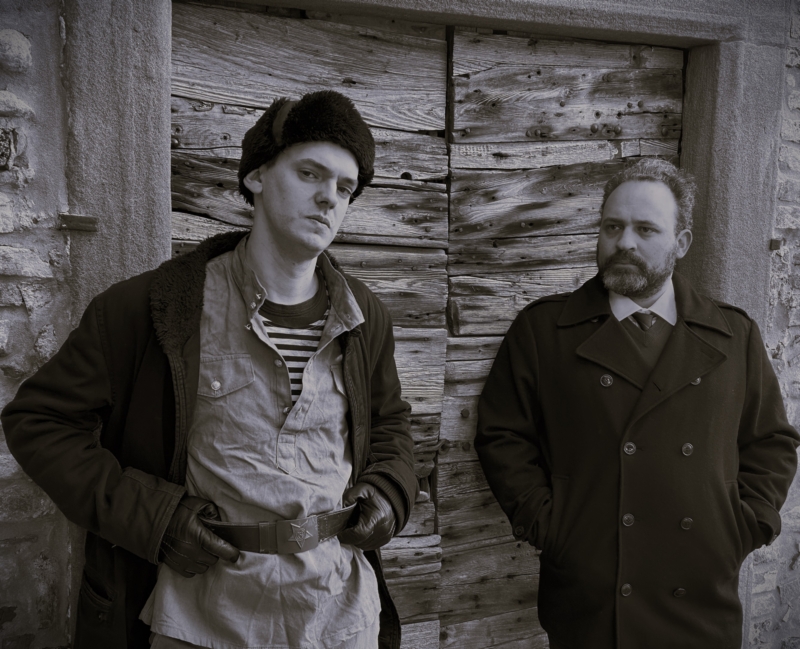
Voland creates symphonic folk black metal and while that may not be super original in itself, their approach certainly is. These two men mix biting black metal with orchestral elements that go further than most other symphonic bands: not just as accompaniment or framework, but as an integral part of the music and based on the work of classical composers (such as Prokofiev). In addition, we hear the “classical” approach in the songwriting, or rather the composition of their songs, and in Rimmon’s warm baritone, which seems to lie just within or just not within the operatic range. In addition to classical music, Voland also integrates Russian folk music and Italian (semi-)popular singing in his work. The result of this unlikely mix of styles is a rich musical palette, full of pathos and bombast, impressive apotheoses and powerful melodies. Heroic, but also catchy and vulnerable.
The music is written from a deep fascination with the Russian language and history. Inspiration comes from historical facts, legends and folklore, but the emphasis is on the people themselves: the difficulties they experience, the victories they achieve and ultimately their passing.
The Grieving Fields is Voland‘s very first full-length album, after three EPs, a compilation and a live album. In fact, the term is a bit misleading, because at thirty-three minutes the new album is actually shorter than the compilation and the last EP. That EP was released by the small label Xenoglossy Productions, but for The Grieving Fields Voland found shelter with the larger, but also Italian Dusktone. As the name suggests, The Grieving Fields highlights the suffering of war and sacrifice: a very currentl theme in that specific corner of Europe. It is a collection of stories from Southern Russia, the Caucasus, Donbas, Crimea and Ukraine. These regions have a rich, shared history that cannot be erased by nationalism or war. The Grieving Fields is dedicated to all who stand up against violence and oppression.
First impressions are treacherous and colored by previous experiences. I went into The Grieving Fields with the idea that this band, which I personally admire a lot and whose previous work I could appreciate enormously, would win me over again from the first minute. I know by now that these two men prefer quality over quantity, sink their teeth into every detail and keep perfecting every aspect of their music until they are one hundred percent satisfied with it (and only then can it be released). But The Grieving Fields did not immediately meet the high expectations.
And there are two reasons for it. First of all, the band opted for a more subtle approach on this album than on the previous EPs. Where songs like 1917 (from the EP Voland 2) and Terza Roma (from the EP Voland III: Царепоклонство – Il culto degli Zar) immediately grab you by the throat and overwhelm you with theatrical bombast, immediately gripping choruses, swirling symphonic orchestral fantasies and intense vocals, the highlights on The Grieving Fields appear to be somewhat less obvious and less easy to reveal themselves. The band clearly does not aim for an overwhelming amount of monumental proportions here, but rather go for variety and nuanced refinement. And that, in my opinion, has to do with reason number two: too much heroism would (given the theme) simply be inappropriate in this period of world history
However, those who do not give up after the first time and give the songs the chance to develop and reveal their secrets bit by bit, will discover in 227 a musical gem of the same caliber as (for example, 1917) Voland‘s best work to date. The song traditionally starts with light, melodic guitar work and expectant drums, but then unleashes its devils by means of a merciless bass drum bombardment, an inspired battery of strings and Rimmon’s bestial (but understandable) voice.
“Not. One. Step. Back!”. Order 227 was an order issued by Stalin in 1942 to the Red Army, stating that it was not allowed to retreat any further, but had to hold out against the German troops. You could chant it, but in reality this one sentence has cost tens of thousands of lives.
Every time you listen to 227, this track (and especially the final passage) seems to mature further into a colossal epic that develops around contrasting emotions. That colossal aspect is then seamlessly taken over by Saturno (the story of the Red Army’s victory over the Italian troops at the Don in 1942: for Voland, these are two worlds coming together…), which in my opinion might have been a better opening track because it ties in much more closely with Voland‘s previous work. It certainly would not have been out of place on Bоланд (2019), the compilation of their first demos, or on Voland III: Царепоклонство – Il culto degli Zar. Monumental brass, coarse growling vocals, warm clean singing (just like on 227 you hear two layers here: one sung normally and one operatic voice), theatrical bombast in the orchestral pieces (great inspiration!) and the simultaneous playing of guitars and strings: it’s all there again. Voland shows two faces here: an evil, foul-mouthed face and a sensitive face, marked by pain and sorrow, but with a pronounced tendency towards drama. Once again the band works with strong contrasts: after a short passage of intimate, acoustic strumming, Voland switches completely towards coarse (yet symphonic) brutality.
After Saturno we enter somewhat calmer waters. ARMIR is a relatively slow, melancholic number with a fiery, energetic flare-up in the middle, which takes its central theme from L’ultima Notte, a song about the disastrous retreat of the Italian troops in World War II. The band changes rhythm and tempo as easily as the central melody at the beginning, but eventually reaches a steady cadence, as the frivolous violin orchestra blends smoothly with (often simultaneously running) melodic riffs, guitar solos and powerful, Italian vocals. Don’t expect too much aggression here, nor too much bombast, but above all a whole range of creative ideas that are interwoven with an irresistible playfulness. There is also a lot of variety on the vocal level, because in addition to the regular singing, the opera singing and the brutal growls, we also hear spoken words in the beginning, which clearly radiates a sad, dejected atmosphere.
After the softer, emotionally charged Don (a song about the fear that the beauty of nature and the simple life of everyday life will be destroyed by an approaching conflict), the folk music returns once more in the acoustic guitar and flute-like synths of Variag, a gentle ballad with a powerful chorus that invites you to sing along (if you have a talent for Italian, that is) and a warm, swirling solo.
“One of the best-kept secrets in the European underground.” That’s what the promo says, and it’s not an exaggeration at all. “Musical unpredictability,” it also says, and that pretty much sums up Voland’s style. What you hear here is a band that doesn’t set itself any boundaries and is therefore delightfully original. This is not music for trve kvlt fans who only drink their black metal black, but for the more adventurous fan with an interest in history, literature, folk music and classical music. The Grieving Fields is a very varied (niche) album full of surprises, strong emotions, compelling passages and beautiful melodies. Give the album time to grow and you will enjoy it immensely!

Score:
87/100
Label:
Dusktone, 2025
Tracklisting:
- 277
- Saturno
- ARMIR
- Rodina
- Don
- Variag
Line-up:
- Haiwas – All instruments
- Rimmon – Vocals
Links: