




Chapter Thirteen. It’s a missed opportunity that this album is being released on Friday the 20th. A week earlier, this thirteenth album by Thy Catafalque – with the Roman numeral in the title – could have been released on its numerical counterpart. But perhaps mastermind Tamás Kátai isn’t concerned with that at all, and I, on the other hand, am being a bit too obsessive in my search for such numerical connections. Still, it’s always interesting to revisit the numerical patterns whenever this Hungarian (on paper) one-man band comes out with new work. While the list of guest appearances on the previous album, XII: A gyönyörű álmok ezután jönnek, was already quite long, this thirteenth release features no fewer than thirty-four names on the roster—and it’s worth noting that, for the first time, a human drummer will be featured.
In addition, we find a wide array of vocalists, string instruments, wind instruments, and exotic additions here. For the sake of convenience, let’s list a full men’s choir, violin, sitar, cello, koboz, kamancheh, trombone, saxophone, and an oboe d’Amore. Connoisseurs of the band have, of course, long known that Thy Catafalque defies genre classification. The avant-garde music is rooted in extreme metal, with black metal serving as a prominent influence. This is counterbalanced, however, by a bombastic array of influences ranging from Hungarian folk music to swinging synthesizers, progressive rock, and subdued soundscapes. All of this is forged together in a way that only Tamás Kátai can achieve. Moreover, it’s always a question beforehand as to what proportions these elements will appear in on the album.
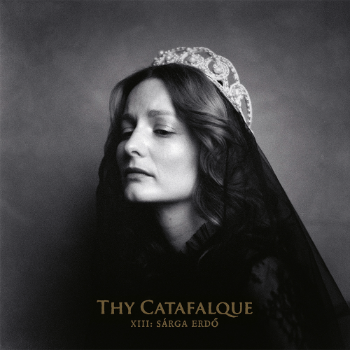
This time around, we’re getting an album that perhaps relies more heavily than ever on narrative compositions and takes the listener on a musical journey. And yet – according to the promotional material provided by the label – XIII: Sárga Erdö is characterized precisely by the absence of a story that ties the songs together. Often, however, the worldly influences, folk instrumentation, and Hungarian vocals transport you to times and places long past. Thy Catafalque has always had a strong narrative character, but this time it feels entirely like the musical equivalent of a historical novel steeped in melancholy. With over an hour of music spread across twelve tracks (why not thirteen, yet another missed opportunity), it’s certainly an album that demands the listener’s attention. It feels as though we can discern a traditional beginning, middle, and end. We’ll therefore review this album chronologically.
Let’s start with the first five tracks, which we can consider the first part of the album. As befits a good album, we’re introduced to the main characters. Búcsú a piros madártól, with its heavy riffs, intense screams, warm folk influences, and a synthesizer solo, offers a good cross-section of what we can expect. The story unfolds further with a number of quiet songs that draw heavily on Hungarian folk influences (Ég-anyám, föld-apám and Suhamló éji fák) or subdued electronic music with jazz influences (Suhamló éji fák). A quiet start to the book – er, album. Perhaps just a tad too quiet, but it’s all presented with great taste.
That leaves us with the finale. As is often the case, the best is saved for last. This is where the storylines must converge into an ultimate climax. It begins with the inevitable confrontation in the form of Tömbök. After a brief introduction, that track bursts out of the starting blocks with old-school intensity, featuring blackened guitars, drum salvos, and thunderous grunts. Aside from a well-placed flute solo (oh yes), that heavy intensity never lets up until the very end. The contrast could hardly be greater with the cheerfulness on display in Kút vizén nap forog, complete with saxophone and trumpet. At nearly eleven minutes, all the elements of XIII: Sárga erdő finally come together in 87 tavasz, 87 ősz, and its strong composition provides a fitting conclusion to an hour of beautiful music.
Score:
80/100
Label:
Season Of Mist, 2026
Tracklisting:
- Búcsú a piros madártól
- Ég-anyám, föld-apám
- Dunnák alatt kék mező
- Szitakötő
- Suhamló éji fák
- Puszta
- Sirató
- Cseremisz
- Sárga erdő
- Tömbök
- Kút vizén nap forog
- 87 tavasz, 87 ősz
Line-up:
- Tamás Kátai – Guitar, bass, keyboard and vocals
Links: