



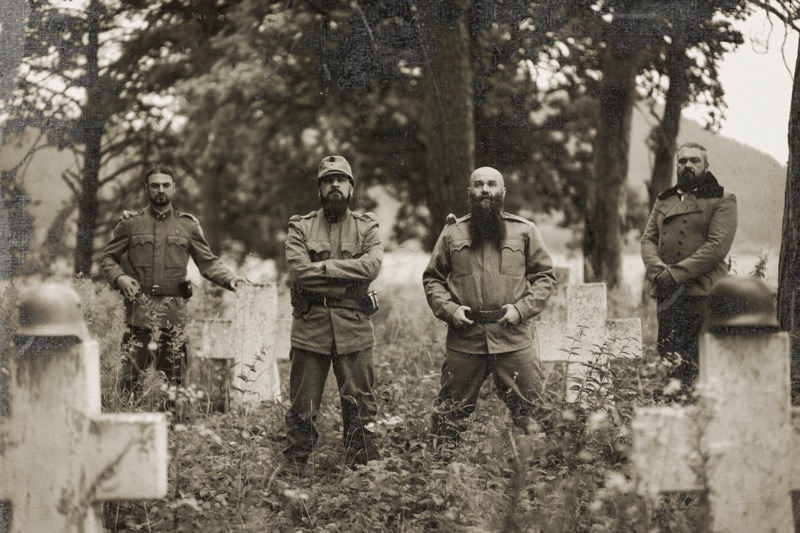
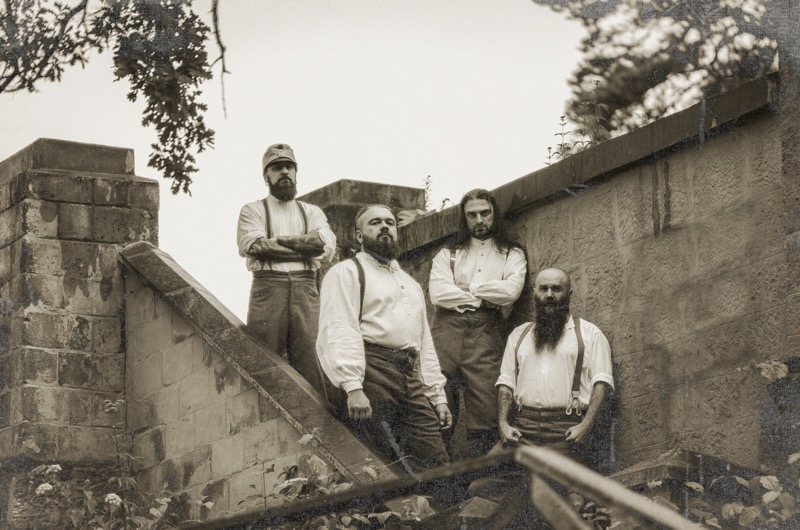
1914 is a blackened death/doom metal band from Ukraine. Their albums serve as detailed historical narratives of events from the First World War, crafted with meticulous precision and vivid storytelling. The band employs a vast array of samples – including authentic recordings, speeches and music from that era – to recreate an atmosphere that draws the listener deeply into the harrowing reality of the Great War. Their fourth album Viribus Unitis is set for release soon. Patrick spoke with k.u.k. Galizisches IR Nr.15, Gefreiter (vocalist Ditmar Kumarberg) about the new record, which this time unfolds from an Austro-Hungarian perspective – and reveals a number of deeply personal insights.

Hi Ditmar, how are you doing? How has your day been thus far?
Hi! It is as always here, hectic but good. I have been working and now doing some interviews for the new album. So, as you can imagine, hectic. It is fun to talk about our new material though, so bring it on.
The new album revolves around the stories of a soldier from the Ukrainian city Lviv (which belonged to the Austro-Hungarian Empire from 1772 to 1918.) who serves in the Austro-Hungarian army. It deals with his fate, his suffering, and his death. The previous albums were set more in countries like Belgium and France. Why did you choose to bring the story closer to home this time?
My main mission is telling stories. I’m a storyteller. I’m not a metalhead because I’m a fan of industrial, noise, punk rock and so on. It may sound weird, but metal music is not important for me. As I told you, my mission is telling the stories. For the past years I have been travelling across Europe and visiting many, many world museums across France, Belgium, Germany, Netherlands, Italy and so on. Many years ago, I realised that in Europe people there don’t know nothing about Eastern Front. They don’t give a fuck about it at all. So, if we talk about the First World War in Europe, of course, everyone knows about Verdun, Passchendaele, Amiens, the Somme and maybe Argonne Forest and that’s all. I call it Verdun trademark. But if we talk about the Eastern Front or, for example, Ukraine in the First World War, in the Great War… zero knowledge. And it hits me hard because, you know, one of the biggest battles of the not even Eastern Front, but of the Great War in total, were in Ukraine. For example, the Carpathian Winter War… two million of losses. Can you imagine? Can you count it? Two fucking millions of losses. If we talk about the Brusilov Offensive, two and a half millions of losses in total. It is even more than Amiens (Hundred Days offensive) at all. But no one gives a fuck because, you know, it’s an Eastern Front, some fucking Slavs and no one gives a fuck about Slavic people. So, okay, two million of Slavs die… okay… It’s not important. But it is.
Even in the last album we had a song – Vimy Ridge (In Memory of Filip Konowal) – about a Ukrainian: Filip Konowal. He was in the Canadian Serbian Expeditionary Force, but he was from Ukraine. So, I prepared it, and I received a lot of feedback, like: “Wow, you are finally singing something about Ukraine.” And, you know, and for me, I know perfectly all this part of history. It’s a part of our Ukrainian history, history of my family. And for me, it’s like a mission to spread those stories around the world and to give you something new to learn. So that’s why, that’s why I decided to sing about the Ukraine in the Austro-Hungarian Empire and the fate of the soldier from my hometown. And you will be educated. I will educate you a little bit more with something new. For example, before this album, did you know where the Przemyśl Fortress is located?
To be honest, Ditmar: I had no clue. As preparation for the interview, I took a closer look into the details of the album. It made the preparation for this talk a bit more excessive for am intrigued after all the details. I have been studying the lyrics and have been looking into all extra details and parts you have been adding, to see what they are all about. And with the opening song being 1914 (The Siege of Przemyśl), I looked into Przemyśl and read about it. I would not have been aware had it not been for your album.
That is great to hear. For the people really wanting to dig into it, I even prepared a book for this album. And this book will be released by Napalm Records as a special edition: a hardcover book with deluxe 2 LP. It is a book of 72 big pages with the vinyls. The book contains the story behind every event, the battles, the main information about battles, about the battlefields, about the soldier’s fate, about the captivity and so on. For me, it is about educational stuff. If you are impressed by the music, you want to know a little bit more the stories behind of it, and you will Google something, you will read this book, and you will find you are a little bit more educated about this huge part of history.
You always use a lot of samples in your songs, so listeners can completely lose themselves in the scenes. Take for example, 1915 (Easter Battle for the Zwinin Ridge). The songs opens with God Save the Tsar, the national anthem of the Russian Empire, which was used from 1833 to 1917, after which the disgust takes shape as you hear the protagonist loudly spitting. Or take the beginning of 1918 Pt 1: WIA (Wounded in Action) which starts with the song Monte Grappa, a tribute to the Alpini soldiers who died during the Battles of Monte Grappa in World War I. Collecting all those samples must have taken a lot of time and research. How do you do that within the context of 1914? Is it all you or others taking part in that as well?
You know, in 1914… I am that guy. I am that bearded man who stand behind every story, every historical part. And of course, research is my part. My musicians are playing the music, but I am a 100% deep inside the storytelling and the historical research. I spent months of time digging in the archives. I have been digging through more than thousand of soldier’s letters from captivities, from the frontline. I read a lot of books, also in the Italian and German language. I do not speak those fluently so had to translate a lot to understand. It took me probably six months. And I have a few mentors. I know a few professional historians, who help me with the research. One is from Vienna; he is working in Vienna archives. Two are from Ukraine and one from Italy and together, they just gives me a lot of input and directions. When I find something in a book and I read about it I like to absorb it and go after every detail of it. I go, for example, to the Austrian historian and ask him after things. I asked him after the Škoda Mörser 305 as I wanted to know if they used it on that hill. He double checks on it and when he conforms I know it is historically correct. So, I can use it in my book. So, you know, with this album I am not reacting like a musician, not like a metal head, but I am reacting like a historian. As far as I know we are the first metal band, which ever prepared a book historical book with their album. Because I did not find any examples of metal releases with a book about the album and the story behind the content of the album. So probably we are the first metal band in the world with such work, with a historical book.
It is important for you for people to dig deep into the lyrics and to go into the details…
I really hate it when people do not dig in deep, when it’s just generic music with generic lyrics, like Sabaton, for example. Sabaton is Walt Disney metal. Their lyrics are from Wikipedia, they probably use a little ChatGPT and are doing so album after album. And the song is literally generic music, for they are about nothing. You cannot learn something new from their music, as they are not digging deep. And for me, it is the worst thing that you could bring into your music. So that is why I am researching. For me, it doesn’t matter how much times I spent on it. It simply does not matter. Research and give a complete story. Prepare a fucking awesome and complete story. And after that go to the people.
May I summarize that as: do not take war as a sort of interesting novelty? Music, like most of the things in your life, should touch people. It should be about who you are. It should be about emotions. It should be about feelings. It should be about trying to learn from things, trying to learn from the past …
The important thing about emotion, emotional stuff behind the music, is that it should be real. We are sitting here in Ukraine, our guitar player is in the army, we are war volunteers. I have split with my daughter more than three years now, because she lives somewhere in peaceful Europe and I am staying here. Every day, we have a drones attack. I have buried a lot of my friends. We have a huge, unfortunately huge, war cemetery here in Lviv. You know, it all gives me emotion, not a positive emotion, but emotions. You know, it is about anger. It is about hate. It is about aggression. It is about despair and a lot of, a lot of emotion. And I just give it to you with my story and with my music.
I feel it in the words chosen, in the music. Somehow you captured it well. To be honest, I can’t even imagine the frustration and the anger in it because I haven’t experienced the war. I feel you can only understand the true meaning of war, if you have been part of it, if I have experienced it. Of course, I realise how awful it is, we see the horror and read and hear the stories
I hope, I really hope that you and your people will never understand us and have this experience.
Thanks; I hope so too. Something completely different: halfway the album seems to shift a little. The pace is going down a bit and an even more menaced atmosphere is portrayed (in songs like 1918 Pt 1: WIA (Wounded in Action) and 1918 Pt 2: POW (Prisoner of War) & 1918 Pt 3: ADE (A Duty to Escape)). I can only imagine that this has something to do with the story’s shift. It is about getting injured, captured and escape. Was a change of pace and adding even more menace something you consciously sought? Or am I completely mistaken? Can you tell a bit about that?
You totally got the point, because the first part of the album, it is really fast and raw, and it is about the war rage. I am an imperial soldier, I fight the enemies, let’s kill them all, let’s fuck them hard. And, you know, it is about blood rage. But in the second part, – in our band we even call it the Doom Trilogy – intensity slows a bit down. It is the moment when his mind changes. It is about tiring of war, about re-changing your mind and your point of view about everything. You are just a tired man who spent many years on this fucking war, and you want just happiness in small things, like a family, embracing your daughter, embracing your wife, go back home and have just a normal life. And it is, you know, it is about being tired of the war, about the love and about I want to go back home. And then there is 1919 (The Home Where I Died). In this part I express my personal feelings the strongest, about my daughter for example. When I finished these lyrics, and when I brought them to the guys, our guitar player checked it and told me: “Ditmar, you know … stop, please stop, stop writing emo songs, because we are not Bullet For My Valentines. You are bringing tears to my eyes.”
They are the most personal lyrics which I ever wrote for 1914. And not only for 1914; these are the most personal lyrics I wrote. When I wrote about our protagonist, I wrote about myself. About my despair, about my hope, about my love, and about my loneliness, and about anger of this war, and everything. I have a lot of emotions.
And to enhance to the feelings of 1919 (The Home Where I Died), you end the album with War Out (The End?). We know War Out form The Blind Leading The Blind and Where Fear and Weapons Meet (I Didn’t Raise My Boy To Be a Soldier), but this time it is different… we get the national anthem of Ukraine.
It is the first historical recording of the anthem ever. I found it in the American archives, it came from the 1916, it came from the World War I period, and it’s the first official recording of the Ukrainian anthem. I felt it adds even more detail to the album. And could you have thought of a better statement to end the album with?
Definitely not. Viribus Unitis is your second release through Napalm Records. What has signing with that label brought you thus far?
I consider it our second and half release though Napalm Records, for they re-released Eschatology of War and The Blind Leading The Blind. Then we released Where Fear And Weapons Meet and this one. So, second and half, ha-ha. I am completely happy with Napalm Records because they don not give a fuck. They do not give a fuck about our songwriting. And for me it is really important and one of the perfect things. They are just asking us, if we maybe have some new songs. And when we say we do, they give us the money for the recording. They don not even need a demo version from us. They just tell us to record it. And that is all. They do not give a fuck about our songwriting, and it is awesome. And when everything complete, I just give the full package, send them the material, and they just check it. Love it.
That means that you are given you full liberty to create whatever you like. Whatever you want…
Yes. That is why this collaboration for me is really important because I heard a lot of stories how the labels can impact and intrude during some mixing album or even lyrics or even music. E everyone who will disrupt my lyrics or music when I’m recording it … just go and fuck yourself. But Napalm Records are really gentlemen. They are from Austria. We were part of Austria. Yeah. Maybe it helps. Haha. We have the same mentality. So, they understand it perfectly. And that’s why it’s easy. Easy collaboration.
You have released videos for the tracks 1914 (The Siege of Przemyśl) and 1916 (The Südtirol Offensive). What made you decide to choose these specific songs as an introduction to the new album? Does Napalm Records give you totally freedom here as well?
The same. The manager from Napalm Records is just telling us that we need videos. We are free to decide, free to create. This time I wanted to make an animation. And you have seen how great these have turned out. You know, when we finished this album and I sent to our manager at Napalm Records, just in a few hours he called me back and told me: “Fuck, Dimitri, you did it again. You brought your music on another level again.” We could not ask for a better response.
With that in mind, is fan response important to you? Is it important how people respond to the music?
I am the person who stands behind all social media in 1914. Because we don’t have any management. We don’t have any social media manager or touring manager even. I just did it by myself. And I must react and even talk with the fans. And, you know, I am not a huge fan of the conversation on the band pages. People just leave their reaction and that is awesome. And when I find the time, I will answer it, but not because I am a fucking rock star. It is just because I have my daily regular job. And I am working from nine till six every day. And I just have not much time to manage everything with social media and so on. But, of course, it’s important for us. I really appreciate it.
One important thing for us: we are not touring at all. We are stuck here in Ukraine. In the past we cancelled an enormous number of shows and tours. When we released The Blind Leading The Blind, Napalm Records prepared us an enormous amount of gigs and touring and probably three months of touring across all Europe. But the COVID started, and we had to cancel everything. We also have zero touring with The Blind Leading The Blind. We never have toured with this album. During the COVID we created it and Napalm prepared us an enormous amount of touring and gigs again. And then the war started and we cancelled everything. But people still love and know our band. You know? There are a million bands worldwide. Awesome bands. In every country. And a metal album is being released probably at least ten times per day. Yet people still know us. When we go to the Netherlands or Belgium or Germany, it is sold out every time. And every time people are like, Yeah, fuck, you are cool. And for me it’s like… fuck, you still listen to us. You still remember us. That is so awesome. So now we are here with a third album, and we will see what happens next.
Time is running out on us, Ditmar. You are on a hectic schedule in a hectic life, so let us wrap it up. I am wishing you all the best. Take good care of yourself, take good care of all your loved ones. And hopefully somewhere, someday around, we get to talk on another moment.
It was a pleasure talking to you. It was a great conversation and sure hope to continue it when we get the change to come to the Netherlands. Hopefully soon. Bye for now.
Links: