


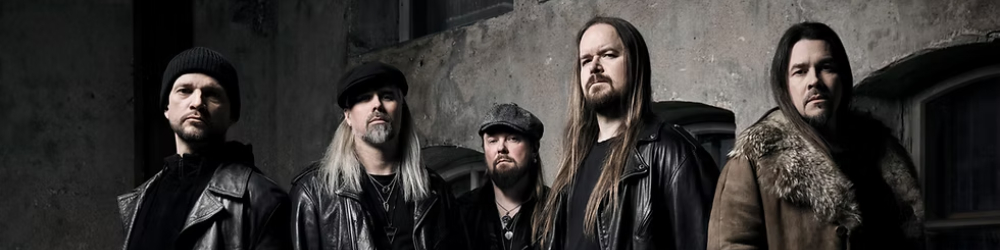

Twice as emotional, twice as melancholy, but also twice as much hope in a dark world. That’s our “Twice as Heavy” column. A new, moving, empathetic album that simply demands to be seen from more than one angle. The editors would also battle it out to determine who ultimately takes home the golden ticket. This time, we’re covering Heretoir‘s Solastalgia. Joris (favorite genre: black) and Patrick (favorite genre: dissonant death) are the lucky ones this time.
The name of the band from Augsburg, Germany, is formed from an expression composed of the word here-, from the English word ‘heretic’, and the French syllable ‘-toir.’ Together, they form Heretoir; a fictional synonym for ‘going one’s own way.’ A perfect, connotative name, because it’s exactly what the German band has been doing for years. Forging their own path, giving their own interpretation to their musical direction. One of black metal, carefully and sensitively interwoven with post-rock. Post(-black) metal, if you will. Or, as colleague Bart so aptly put it in his review of the 2011 debut album Heretoir: ““Brimful of atmosphere. Sultry compositions, with both negative and positive energy. Ethereal and icy, parallel to each other. No shaky instability, but a changeable winter mood. Impulses and thoughts in an almost poetic work. For the connoisseur.”
“We’re living in the shade of a disillusioning truth. What separated you from your own will? From opening your eyes to see the great depression? This is a world lost in degeneration.” (The Ashen Falls)
The new album has been given the catchy title Solastalgia. It’s a word for the sad feeling evoked by changes in your immediate environment, due to factors beyond your control. Seeing the landscape around you change due to a (natural) disaster, human intervention (mining), or climate change affects the human state of mind. Australian philosopher Glenn Albrecht coined the term “solastalgia” for this feeling. Heretoir has always been pure emotion on all their previous albums. Or, to put it more figuratively: the pain of contemporary life translated into music. Does the theme of the new album offer an oh-so-emotional, depressed view of the current state of the world, or is there still some hope on the horizon?
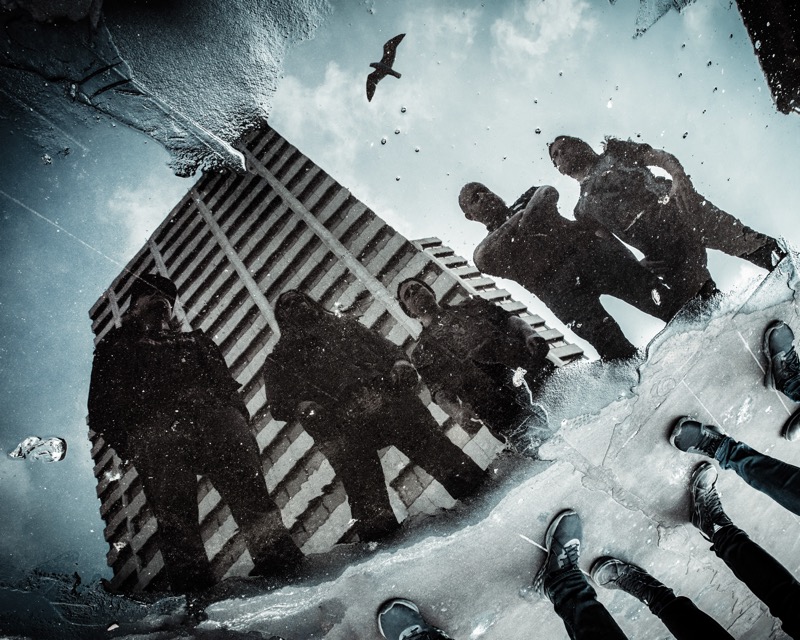
The accompanying text for the promo reads: “After exploring their dark and grim side on Nightsphere, Heretoir has taken a different direction this time. Solastalgia‘s songs span a wide spectrum of emotional and heavy music. From modern metal to black metal to post-rock and perhaps even screamo. Whatever you want to call it: at its core, this is pure melancholy and a glimmer of hope in the deep darkness.” To what extent should we heed the warning about this musical direction change? Where are the changes most evident?
Joris: A change of course? Changes? I see it more as, and I’ll mention it a few more times, as the continuous evolution of a band. Searching for or exploring certain boundaries to let the music take on a more independent life. It’s no surprise to me that a band like Heretoir does this kind of thing. It’s not a band that gets stuck, pinned down to one specific genre, and that’s a good thing, because that’s where the band’s strength lies.
Patrick: In my opinion, words like “taken a different direction” are far too limiting and therefore perhaps misplaced. In my view, there’s no drastic change of direction at all. Aren’t we simply dealing with the band’s development here? Because that’s how I experience Solastalgia: a next step, a further, logical development of Heretoir‘s music. Although the album still features plenty of recognizable characteristics like dense, dark melodies, progressive structures, layered arrangements, long, atmospheric soundscapes, and the combination of a deep black metal scream and emotionally charged, melodic, clean vocals. And even now, the band constantly oscillates between fierce, raw intensity and subdued, melancholic reflection. However (subtly and sensitively) a slightly greater emphasis is placed on a dreamy atmosphere and warm, comforting harmonies, which unfolds an even deeper, dormant melancholy—intense and penetrating—on the album. An emotional shadow is draped over the album like warmth, lying like a warm glow over the entirety of Solastalgia.
Why should you listen to this Solastalgia?
Joris: Because it’s simply a fantastic album. Nothing more to add, and that’s it! If I had to provide a bit more foundation, I’d say that a continuously evolving band like Heretoir always dares to stray from their (post-)black metal, but always returns to it. You can hear in the compositions that the trio of David, Matthias, and Nils have different backgrounds, but manage to blend them perfectly. The latter also has another band that delivers masterful albums. Bonjour Tristesse is definitely worth listening to as well.
Patrick: Why would you choose to pass up such soulful splendor? Heretoir’s earlier work also captured my attention, but this Solastalgia seems to resonate with me in a more thoughtful, more evolved, and more sensitive way. A good example of this is a song like Dreamgatherer. I’m not going to try to capture in words what this song does to me, but I have chosen to simply let it sink in each time. It touches me deeply, doesn’t let me go, and invariably brings with it a wave of tender emotion. For me, music is pure emotion, and it’s at its most beautiful when it touches me to the core and unleashes something within me. And that’s exactly what happens here.
Joris: You can hear the band has grown tremendously. There aren’t many bands where you can say, after 10 or 20 seconds, “It’s this one” or “this one.” Heretoir is one of those bands. Because of their unique sound, which they refine every time, and on this album too, you notice that this band is constantly evolving while still staying true to themselves. That’s why the references to post-rock and screamo are certainly not misinterpreted. Yet, for me, the foundations of this band lie in (post-)black metal.
Patrick: The black metal influences are still present in Heretoir‘s music, although they’re less prominent compared to albums from the early years, like Heretoir (2011) and Substanz (2012) or the more recent Nightsphere (2023). Signature black metal elements like distorted tremolo guitars, the constant tension between aggression and introspection and enchanting, melancholic melodies are still very much present. This time, they’re unmistakably and even more smoothly interwoven with the dreamy layering of post-rock. The playful dynamic is given more space this time around. It’s applied more thickly, harboring just a little more raw emotion and therefore standing out even more. The contrast between songs with raw, powerful intensity, like Season Of Grief, and more tender, subdued melancholy, like the fragile Rain or the gentler The Heart of December, creates a richly nuanced distinction. But even within the individual tracks themselves, such as You Are The Night, Burial, or Solastalgia, mood and emotion shift frequently. You encounter it in Inertia as well, although there’s still a special place reserved for a suddenly emerging, icy squeak, which on first listen, feels like it’s held on for a fraction too long, only to give way to an icy roar. Subtle, distinctive, and expressively applied. By constantly navigating between contrasts, the band manages to create a fascinating tension that culminates in a deeply felt, layered listening experience. One that will be most appreciated when you listen to the album in its entirety.
What are the most moving moments on the album?
Joris: I find the opening track (The Ashen Falls) with its peculiar drums a particularly interesting song. Especially because the variation in the blast section is a monumental piece. Dreamgatherer opens very broadly, truly making you dream in an almost Alcest-like way. The Heart of December initially feels to me like swirling snowflakes in the middle of December. It starts off acoustically, then those incoming toms and clean vocals. Then, even more cold and chill is showered upon you.
Patrick: You’ll encounter many special moments and highlights on the album. And while I’m convinced this record truly shines and reveals itself in all its glory when listened to in its entirety, the songs The Ashen Falls, Inertia, Dreamgatherer, the sensitive The Heart of December, and the title track stand out as true gems (at this moment). The drumming, however, deserves a special mention. Nils Groth’s characterful approach is commendable. The idiosyncratic way the drums connect with the song at the beginning of the opening track (The Ashen Falls) is not only unexpected but simply pure beauty. In Inertia, the drums seem to go in a completely counterintuitive direction, completely at odds with the melodic piano line. Dreamgatherer also features several distinctive, characteristic, and unusual drum patterns, which further enhance the song’s layered quality. The guitar takes center stage in The Heart of December, but the drums swirl beautifully along with this sensitive track, before striking a menacing, defining tone in the following track, Burial. Each moment is a moment where the drums shine.
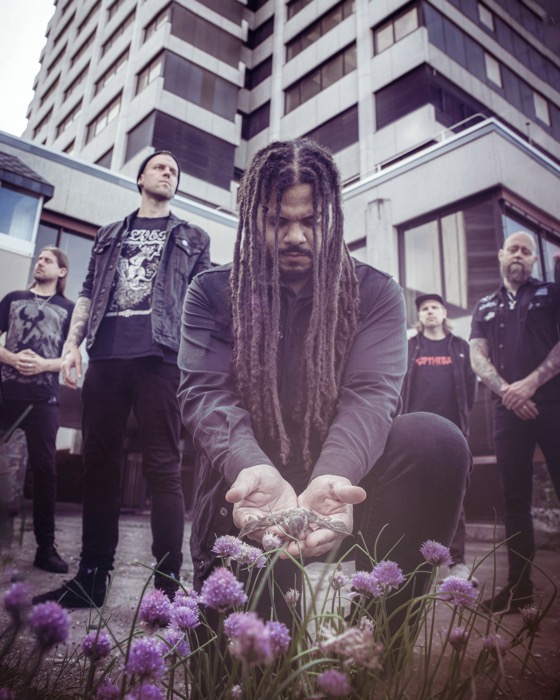
Many of Heretoir‘s lyrics deal with deep and emotional themes, and this Solastalgia is no exception. Which lyrics stand out the most for you?
Joris: Oh, I’ll go through them… I always focus first on the cover, the artwork. If it’s a physical release, everything related to design, and then, of course, the music. I add the lyrics later. I like to follow the vocals without any textual context. For me, the vocals need to be perfectly phrased to the music to serve the whole.
Patrick: I love it when a band delivers thought-provoking lyrics. Sometimes music can be incredibly liberating, but other times I love it when a band confronts me and challenges me to think about all sorts of topics. In those cases, lyrics are an absolute added value to an album for me. With lines like “We never learned to live, only to die. Empty days dominate our lives” (You Are The Night) and “The dawn reveals to me, a world that’s ablaze. Black shrouds cover this realm. A realm that slowly fades” (Solastalgia), the band delivers verbal pinpricks. With these, Heretoir evokes images, intended to awaken something within you. At other times, their lyrics are more direct. With “We’re neck deep in the water. Will there be stories left to tell?” (Season Of Grief) and “We consume this world, like we’re alone out there. Once there’s nothing left, will you still not care at all?” (Burial) pose confronting questions – subtly but oh so effectively. Just try to remain indifferent to them. Or do you feel resonated with them?
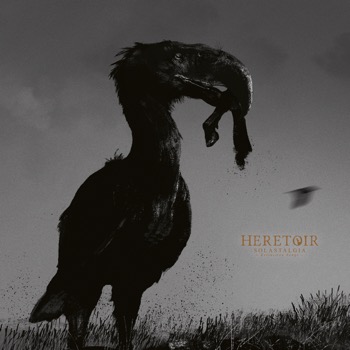
The cover art is a painting by Rudolf Hima, an illustrator and paleoartist who often creates illustrations of prehistoric creatures. To what extent does the cover art contribute to the theme and/or the feeling the album evokes?
Joris: I find this a difficult question, as I couldn’t quite grasp the artwork at first. With a theme that, while very diverse, often fundamentally revolves around the misery on a worldly—let’s call it earthly—but also personal level, I expected a different approach. However, I can certainly understand the choice of this artist. Perhaps the prehistoric creature on the cover is a reference to the primal feeling that resides within each of us. A feeling of survival and, therefore, of continuing to live in a world of change. That’s how I interpret it.
Patrick: The cover art is intriguing, attention-grabbing, and its black-and-white execution lends it a menacing interpretation. The dark image depicts a Phorusrhacidae, better known as a terror bird. The terror bird was an extinct, carnivorous, flightless bird from South America. They appeared shortly after the extinction of the dinosaurs, between the Paleocene and Pliocene epochs. With their sharp talons, powerful beak, and imposing, powerful, predatory form, they evoke their prehistoric predecessors. The Phorusrhacidae will undoubtedly be a direct reference to the album’s title. After all, the term Solastalgia revolves around a changing or lost natural environment. Is the terror bird a metaphor for the relationship between living beings and their habitat? Does it therefore make it a fitting symbol for a break with and detachment from nature: predatory, alienated… and ultimately vanished? Does the album’s subtle subtitle – Extinction Songs – perhaps already give us the answer to this question?
Joris: To be honest, I rarely, if ever, listen to covers. Even when bands like this make them. I always get stuck on the original version and then inadvertently start comparing things, which isn’t always the intention. This time, it was different because the album just kept playing, because I seemed a bit distracted. It’s safe to say that Metaphor might be an odd song choice, but if you’ve listened to the entire Solastalgia album it’s not so strange. The cover has something of an In Flames vibe, but that’s nicely offset by Heretoir’s vibe, that is wonderfully woven into it.
Patrick: Covers are only interesting if a band manages to give them their own character, right? Nobody wants a blind copy of the original, right? Why listen to it when the original is readily available? Yes, Metaphor is still recognizable, but Heretoir, especially thanks to Conrad’s melancholic vocals, gives it a darker, more sensitive interpretation. Furthermore, the band has interpreted the song’s ending slightly differently than the original. Where In Flames opts for a repetitive guitar and drum progression in the last fifty seconds, ultimately letting the song fade out, Heretoir chooses to repeat the final lines. By emphasizing “The sickness that you are, a plague that made me starve. Do you think you can show me, how I’ve come this far?”, the lyrics gain a slightly more powerful impact. This isn’t entirely illogical, as it not only seems to tie in perfectly with the album’s theme, but also proves to be fitting closing words for this album.
Final conclusion: the accompanying promo text from AOP Records states: “Essentially, this is pure melancholy and a spark of hope in utter darkness.” Do you agree with that? Does the album exude confidence and anticipation, or does it envelop you in a glowing blanket of lamentable malaise?
Joris: Well, I do sense a blanket of malaise, yet the music gives you the strength to shed it and look ahead with hope. You can throw off that blanket powerfully, partly because I feel there are enough black, or rather post-black, elements incorporated into the music. You can do this calmly because the compositions also contain a great deal of finesse and delicacy.
Patrick: Where the world seems to be increasingly crumbling, becoming a place where fascist narcissists, with dogmatic, racist political posturing and their latent lies, seem to be calling the shots, the alarming damage to ecosystems, with all its attendant consequences, doesn’t receive the full attention it deserves, and where people in places like Gaza, Ukraine, and Sudan struggle daily to even exist while the world seems to look the other way, a melancholic, gloomy impression would certainly not be inappropriate. And despite this, Heretoir is optimistic. Solastalgia manages to evoke genuine empathy, creating a deeply emotional experience that has an almost reassuring effect. A brief respite from the daily challenges of life, but a soothing response to the hustle and bustle of a constantly changing world? The band itself explains it beautifully: “While humanity as a whole is the biggest problem for the entire planet, it is the individual human being who makes life worth living in the first place.” Doesn’t the trio hit the nail on the head with that?
Score Joris: 90/100
Score Patrick: 92/100
Score:
91/100
Label:
AOP Records, 2025
Tracklisting:
- The Ashen Falls
- Season of Grief
- You Are the Night
- Inertia
- Rain
- Dreamgatherer
- The Heart of December
- Burial
- Solastalgia
- The Same Hell (MMXXV)
- Metaphor
Line-up:
- David Conrad – Vocals, guitar
- Matthias Settele – Guitar, bass guitar, flute, deer bones, vocals
- Nils Groth – Drums, vocals
Links: