

Humanity has always tried to understand its place in the world. For centuries, our ancestors searched for answers in nature, in gods, and in rituals passed down from one generation to the next. Stone circles, ancient chants, and stories about the origins of existence were all attempts to make sense of something that ultimately defies comprehension. The world has changed beyond recognition since then, yet the fundamental questions have remained largely the same. Where do we come from? What connects us to those who came before us? And where can we find our own centre in a world that never stops moving?
These are questions that fit Enslaved remarkably well. Since their formation in 1991, the Norwegian band have never confined themselves to the musical legacy of black metal. Mythology, philosophy, and the relationship between humanity and nature have provided inspiration for decades. At the same time, Ivar Bjørnson and Grutle Kjellson have continually pushed their musical boundaries. What began in the Norwegian black metal scene has evolved into a distinctive musical universe where progressive rock, psychedelic influences, and extreme metal coexist. With their seventeenth studio album, Mið, Old Norse for ‘middle’ or ‘centre’, that ongoing search seems to have become the subject itself.
But what does it actually mean to find a centre? Is it a fixed point where everything converges, or rather a balance between forces that are constantly in motion? Enslaved seem particularly interested in the latter. On Mið, the past is not positioned against the present but serves as a source of new perspectives. Ancient musical traditions find their place alongside modern instrumentation, while aggression and beauty continuously alternate. The result is an album that is not only musically demanding but also encourages listeners to look beyond the music itself.
The first encounter feels like a journey through a deserted winter landscape. In Non-Being, an icy wind seems to sweep through the composition, while the traditional guitar sounds evoke something older than the music itself. It is as though the listener is standing on the threshold of another world. When I Am Ice subsequently erupts, that world proves to be anything but peaceful. A massive wall of guitars, turbulent rhythms, and Grutle Kjellson’s ferocious screams are brought together with the traditional singing of Sámi musician Johan Sara Jr. His contribution does not feel like an exotic diversion, but rather like a voice from another musical tradition demanding its place within the storm.
That encounter is anything but frictionless. Enslaved pile musical ideas on top of one another, constantly shift tempos, and even introduce a synthesizer passage halfway through that initially sounds almost out of place. Yet somehow, these apparent contradictions form a remarkable whole. The track is as fascinating as it is exhausting. The listener barely has time to process one impression before the next arrives. Perhaps that is precisely the point: anyone seeking to connect different worlds must be willing to abandon familiar structures.
Solar Will also demands considerable effort. The furious composition demonstrates just how far Enslaved have moved beyond the traditional boundaries of black metal without entirely abandoning their roots. Deep, icy growls alternate with melodic clean vocals, while the instrumentation continually ventures in new directions. It is impressive, but it also raises a question that resurfaces throughout the album: when does complexity enrich the music, and when does it begin to undermine its emotional impact?
The answer seems to arrive when the band take a moment to restrain their own restless ambition. Mountain begins almost gently, with a melody that gradually gathers strength. The music grows like a landscape slowly revealing itself to the listener. Then, a sudden rupture pulls the ground from beneath our feet, and a crushing riff drags everything into the depths. It is precisely the relative simplicity of this passage that makes such an impression. There is no need for an abundance of musical inventions to evoke a sense of menace or overwhelming power. Sometimes a single riff says more than an entire collection of tempo changes.
Halfway through the album, the search for connection takes on an even more pronounced meaning. On Spirit Helper, we hear the voice of Kevin Kicking Woman, an elder of the Blackfeet Nation from North America. His ceremonial singing is surrounded by music that resembles a ritual more than a conventional metal song. It is a striking moment, not merely because of the musical departure from the preceding compositions, but particularly because of the idea behind it. Enslaved demonstrate that ancient traditions do not necessarily belong in museums or history books. They can still occupy a meaningful place in the present.
When the guitars enter after almost three minutes, a connection emerges between two worlds that, at first glance, appear to have little in common. It would be tempting to regard this encounter as a musical curiosity, but the contribution is far too essential for that. The traditional singing is not merely an embellishment; the composition itself seems to have been built around it. At this point, Mið becomes something more than a musical experiment. The band seem to suggest that different traditions do not need to displace one another in order to create something new together.
Following this almost ritualistic experience, Parting provides perhaps the finest evidence that Enslaved are still capable of transforming their musical ambitions into a genuinely compelling story. Over the course of more than eight minutes, the composition unfolds patiently, gradually drawing the listener into a dark, melancholic world. Here, not every minute needs to deliver a new surprise. The music is allowed to breathe, the tension develops naturally, and a magnificent guitar solo provides an almost emotional release. This is a track in which the band’s technical abilities are entirely at the service of the atmosphere. That is precisely why Parting leaves such a lasting impression.
Tales of Trees also offers a degree of familiarity. Its more traditional structure and recognisable melodic thread provide a certain calm without Enslaved sacrificing their adventurous spirit. It is as though, after all their wanderings, the band briefly rediscover a familiar path. But that moment does not last long. With the closing track I Miðju, every musical register is opened once again. The complexity of the album’s opening returns, and the various facets of Enslaved converge in a demanding finale.
And so the circle is complete, although one might wonder whether Enslaved ever truly intend to reach a final destination. Perhaps that is where the essence of Mið lies. The centre is not a destination, but a place where different paths intersect. The band constantly move between past and future, tradition and innovation, raw aggression and melodic beauty. It makes for impressive music, though not without reservations.
For all their admirable willingness to experiment, Enslaved occasionally seem to lose themselves in their own musical possibilities. Particularly during the opening tracks and the finale, so much is happening simultaneously that the listener may struggle to hold on to the underlying ideas. Not every musical detour proves necessary, and not every unexpected turn strengthens the composition. As a result, the album demands a great deal, perhaps occasionally a little too much.
Nevertheless, admiration ultimately prevails. Thirty-five years after their formation, Enslaved still possess the curiosity of a band only just embarking on their musical journey of discovery. Mið is not an easy album, and it will undoubtedly provoke differing opinions. Yet beneath the complex structures, turbulent guitars, and occasionally challenging experiments lies a genuine search for connection and meaning.
And perhaps that is the most important conclusion of all. Complexity does not have to be pretentious, as long as there is a story beneath it that is worth telling. With Mið, Enslaved have once again found such a story.
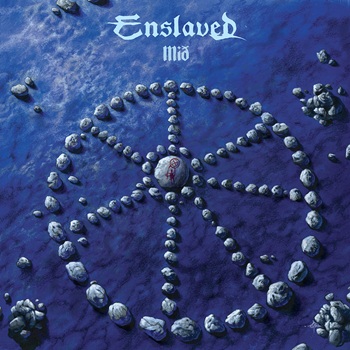
Score:
75/100
Label:
Nuclear Blast Records, 2026
Tracklisting:
1. Non-Being
2. I Am Ice
3. Solar Will
4. Mountain
5. Spirit Helper
6. Parting
7. Tales of Trees
8. I Miðju
Line-up:
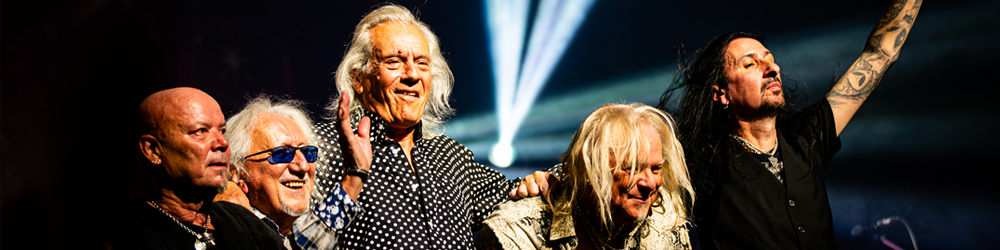
Grutle Kjellson – Vocals, bassguitar
Ivar Bjørnson – Guitar
Arve ‘Ice Dale’ Isdal – Guitar
Håkon Vinje – Synthesizer, vocals
Iver Sandøy – Drums, percussion, vocals
Links: