

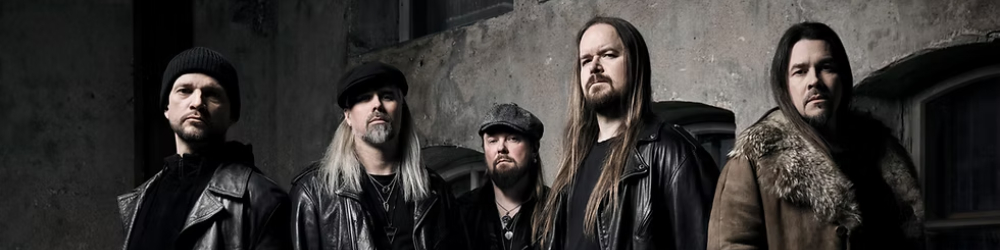




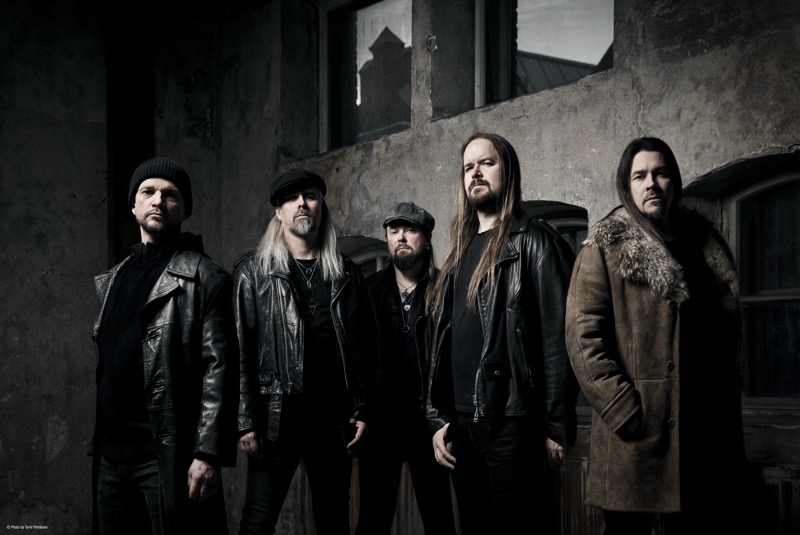
With Netherworlds, Finland’s Insomnium add a tenth studio album to their impressive discography. The band combine their familiar melancholy and sweeping melodies with fresh touches and a greater role for clean vocals. The result is a record that sounds unmistakably like Insomnium, while revealing some surprising sides to the band. For guitarist Tomy Laisto, Netherworlds holds particular significance: it is his first full-length album as a member of Insomnium. A fitting opportunity to talk to him about his place in the band, the making of the new record and the beauty of melancholic music. Tomy takes us into the world behind Netherworlds.
 Netherworlds is Insomnium’s tenth studio album. In advance of the release of the album, the band has spoken about returning to the northern melancholy of earlier records while writing Netherworlds. What does that mean to you as a guitarist? What makes a guitar melody feel unmistakably like Insomnium?
You would probably have to ask the guys who have been in the band for nearly thirty years, haha. There are plenty of great melodies on this album, though. I wrote one of the songs, The Banished, and I’ve been composing for many years. Usually, when I come up with an idea that sounds good, I record it so I can return to it later. The real test is listening again a couple of weeks afterwards. If it is shit, it is shit. But if it still sounds good, I think it’s a keeper. And sometimes you know straight away. When you write a good melody, you just feel that it works. I don’t really know how to explain it, but you know. It is probably similar to hearing a song that instantly connects with you as a listener. There’s something there that you can’t quite put into words. Maybe it’s something from the spirit world, haha.
With three guitarists in the band, how do you divide your roles when a song is being written and arranged? Can you point to a guitar part on Netherworlds that changed significantly as the three of you worked on it?
Having three guitarists becomes more challenging when all three of us are on stage together, because we have to work out who plays which parts. I would not call it a problem, but it does require some coordination. At the moment, Markus and I share the guitar parts, and we keep it quite straightforward: we talk about what each of us would like to play. We ask each other, “Do you want to take this part?” or “Would you like to play that melody?” Naturally, if a solo belongs to Markus, he plays it. When it comes to the melodies and the other guitar parts, we discuss them and divide them between us. He asks me what I would like to play, and I ask him the same. It is a very collaborative process.
When Ville is available to join us, we have to reconsider those arrangements to make room for all three guitars. That is something we will deal with when the time comes. I think we will probably have one or two shows with him as well, but he is very busy with his work as a professor of microbiology. That job also involves travelling, so his availability is limited. Fortunately, he is still very much part of the band.
The idea came from Markus Vanhala. He suggested using The Cold Song as the intro, although we already had another one with acoustic guitars and a very typical Insomnium atmosphere. That original intro is now going to be used on the EP. There was something about The Cold Song that felt right. When we discussed the concept of the album, the opening involved cold and freezing to death, which is essentially what the song is about. That made it a fitting introduction. I think Purcell himself supposedly froze to death as well. It cannot be more fitting.
A perfect entry into the Netherworlds. The album then continuous into your first single Shadowlife. It has a particularly memorable chorus. How did that song take shape? Was that directness part of the song from the beginning?
We agreed as a group that Shadowlife should be the first single because it felt like the song most likely to get stuck in your head. That was why we went with it. I think it sounds great. It is a little poppy, but I love that, and it is fun to play as well.
Enjoying a song as a musician must be important, especially when you will be playing it several times a week on tour. Arch of the Sky was another track released ahead of the album. It has some intricate rhythms, quiet passages and heavier sections. In the longer songs, such as The Hour Grows Late, Arch of The Sky, Ethereal Sleep and Journey’s End, how do you decide when a musical idea has had enough time to develop?
That is a tricky question. I also compose music outside Insomnium, and lately I have been exploring how to write a song that lasts just three minutes. It is actually quite difficult. If I were writing for Insomnium, a song would probably end up somewhere around six to eight minutes, which is fairly long. I do not know what the standards are nowadays, but that is certainly far too long for radio airplay. I think the important thing is not to overthink it. If you do, you can end up making the song too long, and things start to go wrong. I do not have a fixed recipe for deciding when an idea has had enough time to develop. Sometimes you just have to think outside the box.
 It is your first full-length record with the band. When did you feel you had found your place in Insomnium’s songwriting process? What did you want to bring to it? What was the first idea you brought to the band that ended up on the album?
I demoed around three songs, and The Banished was the one we chose as a band. Insomnium are very democratic: everybody can contribute ideas, although the person who wrote the song has the final say. I did not make any drastic changes to the other songs, but we all contributed small arrangement ideas, so everybody was involved.
The song The Banished began as one of your demos. How did it change once the whole band got hold of it?
Actually, The Banished was probably the song that changed the most. My metal background is mainly in thrash and death metal, although I also listen to a lot of seventies rock and other music. You can probably hear those metal roots in the song. When I presented the first demo, the guys thought it had some cool parts but felt that certain things needed changing. I made another version, which they liked better, although they still wanted some adjustments and thought it should be a little shorter. In the end, I made three or four versions. Ville Friman helped me along the way, suggesting changes that would make it sound more like Insomnium. The first version leaned a little more towards death metal. The final song is still very heavy and fast, though. I am not entirely sure, but it might be one of the fastest songs Insomnium have ever made.
One of the most remarkable, but maybe also the most a-typical song for Insomnium, has to be Journey’s End. What would you like listeners to feel when Journey’s End finishes and the album falls silent? What does Journey’s End resolve musically that the earlier songs leave unsettled?
Journey’s End tells the story of a traveller arriving at an inn that welcomes everybody. It is a metaphor for the afterlife: a place where, after we die, we can see our loved ones again. I received my first vinyl copy a couple of weeks ago and have been listening to the album every now and then. I actually listened to it again yesterday, and every time I hear Journey’s End, it gives me goosebumps and almost brings tears to my eyes. It is a very emotional and intense song. To me, it gives the album a powerful ending, and hopefully listeners will feel that as well.
It is a humbling song that evokes a very particular emotion. Markus Vanhala wrote it, and when he first sent us the demo, I remember thinking that it sounded quite unlike a typical Insomnium song. I loved it straight away though: the melody was great, and everything felt right, even though it was something different for the band. The attitude was that we would make it work, and I think it turned out really well.
After The Banished, I would probably say Journey’s End changed the most. Ville’s and Markus’s songs generally stayed quite close to their demo versions. They have been in the band for so long that they know what they are doing, whereas I am a newcomer and still finding my feet. With Journey’s End, I remember hearing Jonathan Hutchins’s narration and thinking, “This is becoming something really massive.” Then we added the vocal layers, and the song developed even further. As I mentioned earlier, when I first heard the demo, it struck me as quite different and even a little unusual for Insomnium. But the narration and all those layers completely transformed it. Now I am in love with the song.
I think those decisions were mostly made by our producer, Miiro Varjus. We recorded the album in stages, with different members coming in during different weeks, rather than everybody working together in the studio at the same time. Everybody recorded their parts, and Miiro coordinated the whole process. When I was recording vocals, he would say, “I would love to hear your voice in this part” and suggest other sections for me to sing. I would give him most of the credit for deciding which voice suited each part. He put a lot of thought into that. Ville Friman has a very different voice from Markus and me. Ville sings in a lower register, my voice is quite high, and Markus is somewhere in between. Miiro worked with those differences to find the right balance.
After the historical stories of Anno 1696, the lyrics on Netherworlds return to personal themes of memory, loss, mortality and the fleeting nature of life through older eyes. Memory and mortality recur throughout the album. What prompted that change? Did a particular experience or feeling bring those themes into focus?
You should probably ask Niilo about the lyrics. I think he wrote roughly ninety per cent of them, with Ville Friman contributing the remaining ten per cent. Niilo likes to work with concepts, and my impression is that he looks at the bigger picture and tries to create a common thread running through the album. It is not a continuous story , these are individual songs, but there is a thematic connection linking them together. Niilo would be better placed to explain that in more detail.
Which songs of Netherworlds will be played live in the upcoming shows? Have you already taken a decision in that or is it too early to say?
We will definitely play the singles and the songs we have released videos for. As we discussed earlier, I really love Journey’s End, but we will have to wait and see whether it makes it into the live set. Let us see what happens. I am trying to remember which other songs there were. It has been a while, since we recorded the album in March.
I see we’re running out of time, so before we wrap things up, is there anything you’d like to add?
All that remains is to thank you for the interview. Hopefully, I will see you somewhere along the way during our European tour. See you then!
Links: