

A seemingly welcoming forest. Wolves can be heard howling in the distance. Guitars slowly begin to rise, and somewhere between the trees there is even a faint sense of euphoria. Anyone who mainly knows Mental Cruelty as a band that once emerged from slamming deathcore might briefly wonder during Weltennacht whether they have put on the right record. Don’t worry. Just keep walking, because the moment Fenrir opens its jaws, that very same forest sucks you in with full force.
Something has changed, though. Quite a lot, actually. Mental Cruelty have been moving further and further away from the deathcore the Germans started out with in 2014. On A Hill To Die Upon, and particularly Zwielicht, black metal, melody and symphonic elements were already given considerably more room. With Echoes of a Forlorn Land, the band takes another major step forward. Black metal, melodic death, folk, power metal, classical orchestration and deathcore are brought together on an album that completely immerses itself in Norse mythology. And that immediately presents a potential danger. Is this whole Viking theme really the next step in Mental Cruelty’s evolution, or have the Germans simply found themselves an extremely appealing new backdrop?
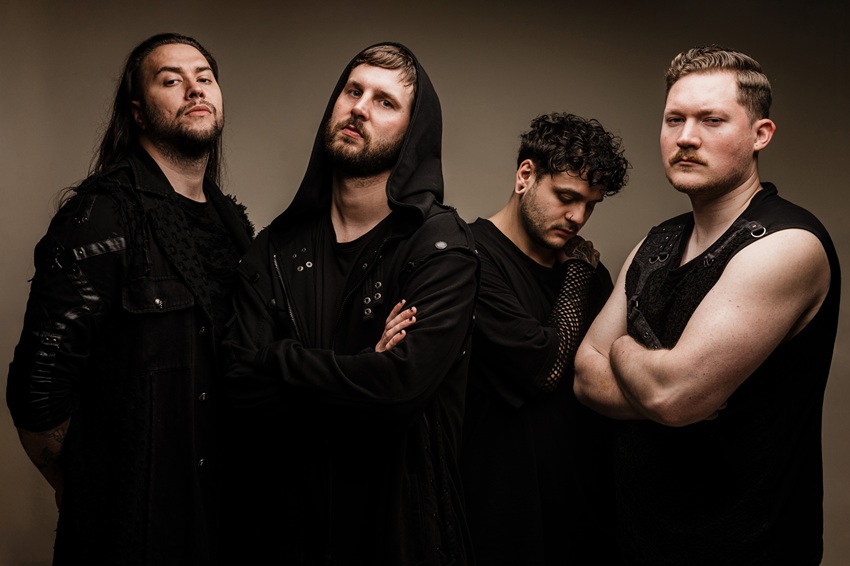
The answer comes surprisingly quickly. After all, the idea for this record did not originate in some meeting room where someone decided that Vikings happen to work well in metal. The seed was planted during a visit to a bookstore inside Portland’s Central Library. Vocalist Lukas Nicolai began delving into Norse mythology. At the same time, guitarist Nahuel Lozano was obsessively searching for a way to unite Mental Cruelty’s ever-expanding metal influences with the band’s deathcore foundations. On Echoes of a Forlorn Land, those two developments meet almost perfectly.
Take Fenrir. The son of Loki and Angrboða is destined to play a major role during Ragnarök and is therefore bound by the gods. Mental Cruelty tell the story of a beast that refuses to be restrained and eventually breaks free from its chains. The music behaves just as unpredictably. Pure black metal opens the track, before the rhythm shifts and classical elements settle in behind the violence. It is aggressive and crushing, yet remarkably atmospheric at the same time. Those additional layers do not diminish the brute force; they give it an extra push.
On Blood For Blood, Mental Cruelty even stray dangerously close to the edge of kitsch. A fairly clichéd Viking melody opens the song. You almost expect someone to raise a drinking horn somewhere. Then the scorching guitars and vocals come crashing in, while that same little melody cheerfully continues to haunt the background. It really should not work. On paper, deathcore and this kind of folk have very little business being together. Yet something irresistible emerges from that strange combination.
This becomes even clearer on The Serpent Of Midgard. Here, the Mental Cruelty of Zwielicht and the band we are getting to know on this album perhaps come closest together. Jörmungandr lies beneath the waves, awaiting his confrontation with Thor, one that will ultimately prove fatal to them both. Mental Cruelty give that confrontation a truly breathtaking pace. The drums race past at an almost unbelievable speed, the vocals cut deep and, despite the sheer amount of sound being thrown at you, the song remains standing. Until everything finally slows down and there it is: the first breakdown. As if Thor himself is bringing his hammer down on an anvil, metal crashes against metal. The guitars drop lower, everything becomes heavier and slower, only to erupt in full force one final time. This is still unmistakably Mental Cruelty, only the band has considerably expanded its playing field.
Raise The Raven Banner begins on an epic note. Almost instinctively, you picture an army of Norse warriors preparing for battle. The raven banner flies above their heads, and then the entire horde charges forward. Mental Cruelty play brilliantly with tempo, melody and structure here. One moment, the gang vocals and aggression demand raised fists; mere seconds later, the entire battle formation transforms into a chaotic circle pit. That makes Raise The Raven Banner the standard-bearer of Echoes of a Forlorn Land both literally and figuratively. By far the best song on the album, it is also an excellent summary of everything Mental Cruelty are trying to achieve here. Even lyrically, it goes beyond the mere clashing of weapons. After kingdoms have been trampled and bodies set ablaze, another question suddenly emerges: what will remain of it all? Will anyone still remember this warrior’s name after a thousand winters? Will his story eventually become legend?
Where Mental Cruelty usually impress by making everything bigger, faster and more violent, on Frost the band dares to create space instead. The melodramatic opening slowly drains all warmth from the surroundings. Drums and violins linger in the background, while the tempo drops to such an extent that the song occasionally almost drifts towards sludge. As a result, the eternal winter Nicolai sings about is no longer simply a story laid on top of the music. You can feel it. The lyrics describe a world where sunlight no longer reaches the earth, the gods remain silent and wolves wait in the distance. Every step through the snow brings the narrator closer to death. Halfway through, an icy voice seems to emerge from the winter itself, after which Mental Cruelty once again pull out all the stops. All those elements that elsewhere occasionally seem to be competing with one another suddenly fall perfectly into place. Eventually, all that remains is the freezing wind.
Could Mental Cruelty have written this music without Norse mythology? Technically, perhaps. The blast beats, breakdowns and scorching vocals would probably still have been there. But Echoes of a Forlorn Land would not have become this album. The stories determine how the music moves. They introduce different instruments, alter tempos, create melodies and force Mental Cruelty beyond the boundaries of the genre in which the band once began.
That point is driven home one final time on Ride Of The Valkyries. At first, the closing piece feels like a work of classical music, until a rampaging horde of Norse warriors comes charging straight through the orchestra. Everything is allowed to come together one last time: symphonic grandeur, melody, extreme metal and the merciless aggression of the band’s past. Eventually, the Valkyries carry the fallen warriors upwards, their bodies disappearing while their stories live on.
And with that, our original question receives its definitive answer. Norse mythology is not some cheap backdrop Mental Cruelty have erected for the occasion. The band have immersed themselves in it so deeply that the stories have genuinely become part of the compositions. Of course, it occasionally brushes up against cliché. Of course, at times it is almost overwhelmingly busy. But just when you think there is absolutely no room left for another layer, Jens Bogren somehow manages to forge the enormous mass of instruments, orchestrations and violence into a coherent whole. And that may well be the greatest achievement of Echoes of a Forlorn Land. Mental Cruelty do not sound like a band trying to escape their deathcore past. Instead, they take it along for the journey and introduce it to black metal, melodic death, folk, symphonic music and a world filled with gods, wolves, serpents, ravens and fallen warriors.
What began in Portland with a few books on Norse mythology ends here as a new musical identity. Raise the raven banner!
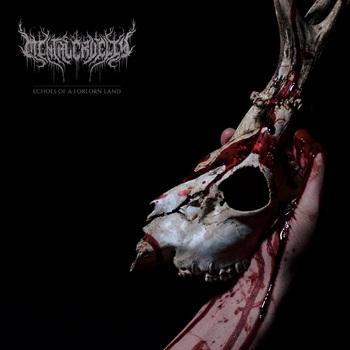
Score:
90/100
Label:
Century Media Records, 2026
Tracklisting:
- Weltennacht
- Fenrir
- Blood For Blood
- The Serpent Of Midgard
- Helheim
- Draugar
- Raise The Raven Banner
- Cry Of Batariel
- Frost
- Dämmerbruch
- Ride Of The Valkyries
Line-up:
- Lukas Nicolai – Vocals
- Nahuel Lozano – Guitar, vocals
- Marvin Kessler – Guitar
- Jonathan Koltun – Drums
Links: