










Black Spikes are a Lithuanian metal band that blend modern metal with progressive, electronic and atmospheric elements. With their debut album NIL, the Vilnius-based group began shaping a distinctive sound built around heavy riffs, electronic textures and a strong visual identity. On Ydos, their second full-length album, Black Spikes take a darker and more layered approach than before. The release therefore offers a fitting opportunity to speak with vocalist Agni and guitarist Mazvis about the band’s musical evolution, the ideas behind the new record and what their partnership with Napalm Records has meant for Black Spikes.
Hi Agni, hi Mazvis, how are you both? I hope everything is going well. We were supposed to talk last week, but you had to cancel because you had to take your daughter to the hospital after she broke her finger, Agni. How is she doing now?
Agni: Yes, I thought that she had broken her finger after a fall, but examination at the hospital showed she didn’t. So, I’m so happy. Also: it was the day before our holidays. Our holidays would have started very bad if she had broken her finger. But luckily, none of that. By the way: I am sorry for cancelling that.
No need to worry about that cancellation; totally understandable. Well, with no injuries and hopefully a rested mind after the holiday, let us have a look into your new album Ydos.
Agni: Sure. Let’s see what you want to know.
The title Ydos refers to human vices or flaws. In the ten songs, you explore the relationships with the flaws we all carry within us, dedicating a song to each flaw. When did the idea arise to give each vice its own name, personality, and story? Why did you want to make a full album specifically about the dark sides of humanity?
Agni: Well, just look at the world around you. It’s not that difficult to come up with examples of humanity’s flaws, is it? I remember Sime, our bass player, and I discussing the idea during one of our writing sessions. This time, we had a clear goal from the start: we wanted to write a full album, which was quite different from how we had worked before. In the past, we mostly wrote songs one by one or gradually put together an EP, sometimes using material that had already been around for a while. While talking about the new record, we began looking at bands that had created conceptual albums and thought: “Why not try something similar ourselves?” From there, the idea came together quite naturally.
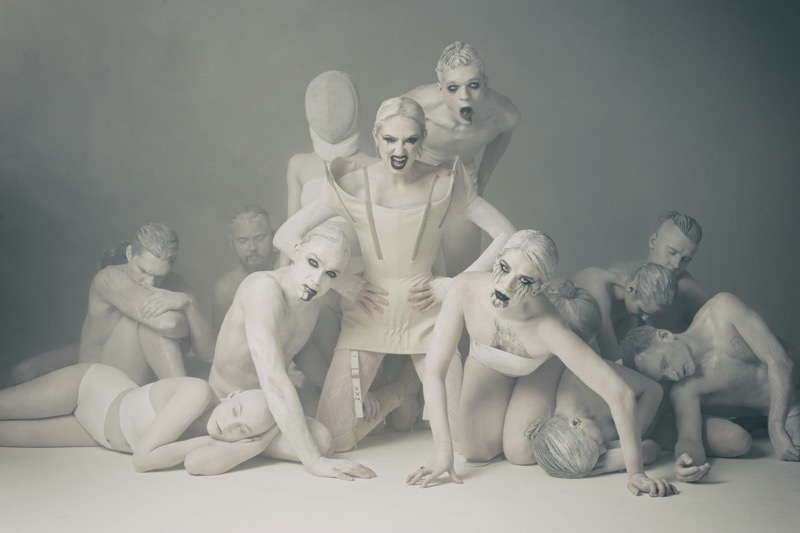
At the very beginning, the idea was driven by the visual concept. We already had this location in mind, and Sime and I started imagining what kind of image we wanted to create there and what sort of story we could tell in that setting. The place itself was covered in this completely white material that looked like sand, although it wasn’t sand, but some kind of chemical by-product from an industrial process. That’s the location you can see in the Motina video. Once we had that image in our heads, we started thinking that it could make an interesting setting for a music video.
We liked the idea of something being born on this pure, almost untouched landscape. From there, the thought of these figures being demons came quite naturally. Then we started asking ourselves who they were and what they represented, and that led us to the idea of them embodying human vices: demons descending to Earth and interacting with people. I think the original concept really grew out of that visual image. We simply started imagining what could happen in that setting. That is often how I approach lyrics as well. A song can begin with a visual idea: I see an image that feels beautiful or intriguing and seems to contain a story, and then I start developing that story through the lyrics.
Isn’t that visual aspect very important for Black Spikes in general? Your videos consist of dark, theatrical, and surreal visual language, with extravagant costumes, alienating makeup, ritual symbolism, and carefully constructed sets. Do you come up with ideas for this yourselves, do you collaborate with a company that devises and shapes the concepts, or do the ideas come from Napalm? To what extent are you involved with the characters, costumes, and surreal visual language? What can you say about this?
Mazvis: Funny that you mention it. With almost every music video, there comes a point where someone suggest: “Maybe this time we should just film the band playing somewhere.”
Agni: Perhaps we will do that one day, when we have finally run out of ideas. But for now, that hasn’t happened.
Mazvis: So far, every video has been more like a small film, with its own story and plenty of details to discover. That makes each release more exciting as well, because we are curious to see how people will respond not only to the song, but also to the visual story that comes with it. The video is meant to be much more than simply footage of us performing the track. Of course, we may be making things difficult for ourselves by setting the bar so high. But at the same time, it is a lot of fun for us too. We’re always excited to see the final edit and discover how all those ideas have come together.
Agni: In fact, that idea of creating something like a mini movie is very much part of our songwriting process. The visual concept often comes first and then becomes closely connected to the music. I have written many songs that way. As I mentioned before, I usually start by visualising a story, and that naturally helps me develop the lyrics and complete the narrative. Once you already have that vision in your head, it also becomes much easier to create the music around it. You are no longer starting from nothing or trying to find images for a song that didn’t have a clear idea behind it in the first place. The concept is already there in your mind; you simply have to turn it into something concrete.
Do you recognize certain vices that appear on the album in yourself? And did that make the writing more personal or, conversely, more uncomfortable?
Agni: Oh yes, I think there is a little bit of ourselves in each of those flaws. We have all experienced them in one way or another. I think all of us encounter these kinds of flaws at some point in our lives. Nobody is flawless, so in that sense, they’re simply part of being human. Revana though, which deals with revenge, was quite difficult for me to write from a lyrical perspective. I’m not really the kind of person who holds on to things or looks for revenge. I tend to let things go and move on, so it was difficult at first to find something personal that I could connect to that feeling and build the lyrics around. Eventually, of course, I did find something.
Mazvis: I think that last one: more as a natural selection. Even on the previous album, we were already combining and mixing electronic elements with heavier riffs. With this record we lean much more into the electronic side of things. A lot of the songs started with us finding something interesting whatever it was, a sample, a sound or simply a certain concept, and then building the rest of the track around that. So, I think that shift happened quite naturally. If you start forcing yourself to look for certain elements, they don’t really become part of who you are. Your music has to reflect you, rather than what you think people want to hear. At the same time, we also try to keep moving forward and avoid repeating ourselves too much.
Isn’t that a challenge for a lot of musicians? You want people to recognise your sound, but at the same time you also want to explore new ideas and keep evolving. The difficulty is finding the right balance, because you never quite know how listeners will respond if you change too much.
Mazvis: Honestly, I don’t really think about it that way. Whenever I hear musicians say, “This album is completely different,” you usually listen to it and still immediately recognise who it is.
Agni: For the musicians themselves, the differences might feel huge, but listeners often do n0t even notice those smaller changes.
Mazvis: I don’t think we consciously try to sound like Black Spikes. We simply do what feels natural to us, and in the end, it just comes out sounding like us. And that’s perfectly fine. We use so many different elements in our music anyway, that there is plenty of room to experiment and evolve without losing our identity.
You indeed employ many different elements in your music. In Melas, for example, trap beats and rap are combined with modern and progressive metal, among other things. How do you ensure that all those differences continue to sound like a cohesive whole? How do you prevent such disparate elements from sounding like separate additions?
Mazvis: That’s a good question. Our songwriting process is usually very iterative. A song might start with a guitar riff, perhaps combined with some programmed beats, and we’ll treat that as the first version. Then Agnieszka might take it and send it back in a completely different form, with something like a rap section added, and suddenly we realise that it works really well. From there, we go back to the original idea and adjust it so that the different elements fit together more naturally. So, there’s usually quite a bit of back and forth before everything really comes together. A lot of massaging, basically. It just goes through a lot of steps until it sounds, somewhat cohesive.
Agni: I think one of our strengths is that three of us are heavily involved in writing the bulk of the music. Yaga is a very talented songwriter, so a lot of the initial ideas come from him. I tend to experiment with those ideas quite freely, cutting parts, changing things or adding something completely different. Then you have Sime, who is a huge black metal fan and might suddenly say: “This part needs to be more black metal.” And we’ll try it. What works well for us is that we don’t immediately dismiss anyone’s ideas. There isn’t one person deciding what is right or wrong, good or bad. We simply bring all these different influences together, are open about it and try to make them work.
The lyrics are once again largely in Lithuanian, while Black Spikes now reaches a much larger international audience via Napalm Records. Why does singing in your mother tongue remain so important? Can you express emotions differently or more intensely in Lithuanian than you could in English?
Agni: You are absolutely right, that using your native language makes it easier to be honest and go deeper lyrically. That’s one of the main reasons we still write in Lithuanian. When Titas and I started the band, we had a very clear feeling that we were a Lithuanian band making music for Lithuanian people, so writing in our own language felt completely natural. At the beginning, we never really had a strong ambition to reach an international audience. We were much more focused on the Lithuanian scene. Over time, though, we realised, much to my surprise, that foreign listeners find the Lithuanian language interesting. I am very happy about that now, and it’s something I cherish. If I started singing the same songs in English, I think we might end up sounding like a thousand other bands. This is more genuine.
Mazvis: We did some A/B testing with certain songs, trying them in both English and Lithuanian, and in some cases the Lithuanian version simply sounded better. It gave the songs something more distinctive that we felt was missing in English. At the same time, we try to provide translations for people who are interested in the meaning behind the lyrics. Sometimes just knowing what a song is about, for example that it refers to a particular witch hunt, adds another layer to the experience. Having that bit of context can give the song some extra depth. And if it fits, we will add English. We have a couple of songs that has English in it.
Agni: For example, we have one song with a chorus in Ukrainian (editorial: Užkalbėjimai / Замовляння). I wrote those lyrics shortly after the war began, although we didn’t release the song until two or three years later. By that point, I wondered whether we should rewrite that part in Lithuanian, just to keep everything in the same language. But when we tried it, it simply didn’t sound as good as the Ukrainian version. I have had a similar experience when trying to write in English. Sometimes it just doesn’t feel right. So, we’re not completely against using other languages, but only if they genuinely fit the song.
Mazvis: Some people might care about understanding every word, but I think metal is a genre where language is less of a barrier. You’re already used to vocals that involve screaming or growling, where the lyrics aren’t always immediately understandable anyway. That usually doesn’t stop people from listening to the music, not in metal at least.
Ydos will be your first release through Napalm Records. What changed for Black Spikes after you signed with them, both practically and in the way you view the future of the band?
Agni: I think the most important thing is that we’re still here, we are still alive, and in many ways that’s thanks to Napalm Records. They found us at exactly the right moment, when we were struggling with the motivation to continue with the band. After they came along, things started to change, and now we feel much more motivated and are putting a lot of energy into the music again. So, in that sense, they really did save us. For us, signing with Napalm Records is a dream come true, especially coming from such a small country. There aren’t many bands from Lithuania, or even the Baltic countries, that get the opportunity to work with a label of that size. Having a company like that believe in what we’re doing has given us a huge amount of motivation and confidence to keep moving forward.
You are not exactly a conservative band when it comes to music. Many people in the metal scene are considered quite conservative, although there are also many people who are open to new things. This probably means that many people have their opinions formed, and with social media, they are quickly tossed out into the world. How do you deal with this kind of criticism?
Agni: I think we had been in that position for many years in Lithuania. The metal scene here is quite small and, in some ways, fairly conservative, so for a long time we were something of the black sheep. A lot of people here are into old-school death metal, black metal and other more traditional styles. We came along with things like trap beats, so we never really fitted into that scene. As a result, we received quite some different, not so positive feedback over the years. That was also one of the reasons we started losing motivation to create music. We were putting so much time, effort and money into the band, while often feeling that what we were doing wasn’t really understood or appreciated at home. For a long time in Lithuania, we felt that what we were doing only mattered to us. And if you feel that way a very long time, eventually you start wondering why you should keep going.
Mavis: That’s why Napalm Records gave us such a huge confidence boost. It became much easier to ignore the negative comments once we knew that someone believed in us and was willing to support the band on that level.
Agni: Since signing the deal and releasing the new songs, we’ve also noticed far fewer negative reactions, especially from listeners abroad. So right now, we feel much more confident about what we’re doing. There were moments in the past when being a band like ours in Lithuania was difficult, but things feel very different now.
Mazvis: I think we have also simply found our crowd; the people who genuinely connect with what we do. And that’s probably the best part of it.
Agni: We already have a few festivals lined up for next year, and we’re also planning an album release show here in Lithuania, probably in October or November. Beyond that, though, there are no major touring plans yet. We are discussing possibilities for next year and are really looking forward to seeing what comes together. I’m confident something will happen, but now nothing concrete has been arranged. Whatever we do also has to make sense for us; it needs to be an interesting opportunity and something that fits realistically into our lives.
I see we’re running out of time, so before we wrap things up, is there anything you’d like to add? Maybe a question for me, or perhaps some famous final words?
Agni: Thank you so much! We are good like this. I’m just very curious, do you recall maybe songs which you like the most?
In general, I really like the strong dynamic contrasts and the variety in the vocals. That comes through particularly well in songs like Melas, Mara and Apatija. The track that stands out most to me, though, is Aurea, the first single. It opens with an intriguing dance beat before the blast beats come crashing in beneath ethereal vocals. Then, for a brief moment, the song almost falls silent before the roaring vocals take over. There’s an incredible amount of contrast packed into a very short space of time. The video adds another layer to the song as well, with its depiction of three different stages of life and the little girl running through it.
Agni: Thanks for the feedback. And are you surprised if I tell you that the girl in the video, is the girl which almost broke her finger?
That is what I more or less thought, but was not sure about, Thanks for the confirmation. May I say I love such an extra personal touch to the video? Well, thanks again for your kindness and openness.
Agni: Thank you, Patrick. Have a great weekend, take care, and maybe we’ll see each other during an upcoming tour. Until then!
Links: